Mike Magee
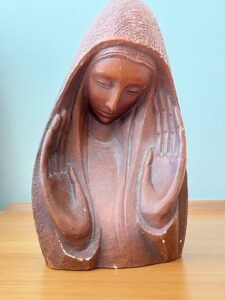
The item above is “a vintage mid-century religious statue of the Virgin Mary, commonly known as the ‘Model of the Virgin’, produced by The Grail Pottery in Loveland, Ohio” according to AI. I bought it for $12 as a Christmas present for my mother when I was 15 at a department store in Paramus, New Jersey.
I am uncertain why, in December of 1963, I thought to purchase it, or why she liked it enough to display it on her bedroom end table over the years, and (shortly before her death from ovarian cancer at age 79 in 1995), made certain to gift it back to me with the words, “Michael, you should have this.”
I was drawn to this piece of personal iconography this week after reading New York Times critic at large, A.O. Scott’s discussion of British art critic, John Berger, who died in 2017. In the opening, he quotes Berger as writing, “You can’t talk about aesthetics without talking about the principle of hope and the existence of evil.”
Scott himself is clearly moved when he writes, “The idea that art can offer a measure of hope in bad times is a commonplace these days and can easily slide toward sentimentality and escapism. But for Berger art offers not a refuge so much as a way of living in history, of grasping the complexity of the past and the individual’s changing relationship to it.”
In the days before I purchased Grail’s terracotta pottery “Mary”, my mother, her husband, and her other children were still recovering from the tragic loss of our 4 year old sister, Mary Regina, to drowning a few years before. Perhaps I was motivated by my love of a suffering mother who herself had lost a child – gifting her “a measure of hope.”
The truth is, I don’t remember exactly my emotions or reasoning at the time. I only know that this tangible piece of art was well received. I find that comforting. As Scott uses Berger’s quote to reflect on the power of Art – “We live in a world of suffering in which evil is rampant, a world whose events do not confirm our Being, a world that has to be resisted. It is in this situation that the aesthetic moment offers hope.”
Rev. Dr. Sarah Coakley, an Anglican priest and philosopher of religion, and former professor of divinity at Harvard might describe my mother’s other “Mary” as “contemplative prayer – a crucible of purification.”
Rev. Coakley, recently reflected (in an interview with Times columnist Peter Wehner) on the path she took as a young teen, organizing a peer discussion group to challenge the inadequate performance of their parish priest in England. Looking back on her actions, she said, “There are lots of good reasons for not believing in God, and sometimes those reasons have seemed overwhelming. But I have great difficulty in not believing in God.”
That reminded me of my mother’s oft-repeated tale of her path, as a 15-year old, in attending a variety of churches in her Grantwood, N.J. neighborhood before choosing to convert to Catholicism, and abandon the Protestant religion she had inherited from my British grandparents who had emigrated to the U.S. in 1900, days after their marriage.
My mother could have benefited from the reassurance and understanding of Rev. Coakley, who said, “Belief isn’t a one-off achievement. It’s a journey. And of course, that’s obvious, but most of us don’t think about that very much. The idea that signing on to faith might involve stages of development in which very grave doubts arise and very great despair about whether one would have to change one’s whole view of God in order to accommodate what one is going through or what the world is going through, that’s part of the package.”
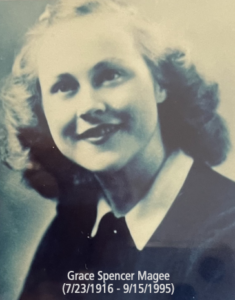
Instead she got this statue from me, and a lifetime of love and fidelity and caring from her husband and children. And hopefully that was enough. If not perfection, it was received as loving cooperation, in creating a systemic future for herself and all of us.
Of this, Rev. Coakley reflects, “What’s particularly interesting about the phenomenon of cooperation at the moment is that its meaning is being contested. Because what the mathematical exploration of it has shown is that pure competitiveness, individual competitiveness, in any evolutionary population, is ultimately at the cost of declining average fitness in the population as a whole, if done in excess. . . . We can decide that the only meaning in life is that we compete until we’re dead. But we have a choice.”
It’s a special comfort that “My Mary” has survived. Peter Wehner acknowledges as much at the end of his interview, when he cues up this reality by saying to Rev. Coakley, “You’ve written about religious truth being expressed aesthetically, noting that through art, poetry, and music, ‘dimensions of divine truth are evoked which can be found in no other way.’”
And Coakley responds, “We need to talk about what we think a human being is at this point. We are made in the image of God, but made with an astonishing, rich array of responsive capacities. And these include intellectual responses, moral responses and feeling responses. The aesthetic arena of our life, our response to beauty, has an extraordinary capacity to gather these up. It has an integrative function in itself.”
Clearly perfection is not in the offering, and diversity is baked in. But my mother was not alone in her suffering, and nor are we in the hands of a tyrant one week from elections.
Where do we begin? On this, Rev. Coakley is clear. “You begin to see that actually there’s no prayer that isn’t already communal prayer, and that there’s no undertaking of this sort that doesn’t impress on you that we are much more bound up with each other than we think. It’s actually quite frightening that the boundaries of selfhood are much more porous than we think.”


2 replies on ““My Mary””
Excellent from a colleague whose path to the divine is natural beauty and the arts 🙏
Thanks, Rick. Best to you and yours! Mike