
 Mike Magee
As an aging American, Fall is vaccine season. The question, “Have you had your Flu Vaccine?” at doctors offices and retail pharmacists, has now been supplanted by “Have you had your Flu, Covid, and RSV vaccines?”
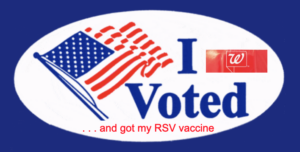
Being pro-public health (“All for one, one for all”) in an age of RFK Jr. Measles epidemics, I was especially judicious this year, and proceeded with multiple injections at my local Walgreen’s, as proud to wear my “red W bandaid” as I was to display my “I voted” sticker a week or so ago.
But only now have I caught my breath enough to ask the question, “What is RSV?” Here are six facts you should know:
1. Respiratory Syncytial Virus (RSV) is a single strand RNA respiratory virus that infects the respiratory tract. When it penetrates those cells it triggers the formation of large multinucleate infected cells – thus the name “syncytia.”
2. RSV was first identified in chimpanzees with lung infections in 1956. A year later, [pediatrician and NIH researcher Robert M. Chance, identified the same virus in children with respiratory infections.
3. RSV complications are most common in newborns (especially preme’s) and elderly over the age of 74. Approximately 160,000 adults in the US are hospitalized with respiratory complications of the virus each year and secondary complications including asthma, COPD, and heart failure.
4. There are now three vaccines ( Arexvy (GSK), Abrysvo (Pfizer), and Mresvia (Moderna)) and a monoclonal antibody to treat the disease in at-risk populations. The preventive results of these treatments have been more than encouraging. As a recent article in Nature proclaimed, “RSV vaccines slash infections.” Vanderbilt pediatrician, Buddy Creech, recently commented “It’s just remarkable, from no mechanism to prevent RSV to an embarrassment of riches.”
5. The government of Denmark was convinced enough of the value of the vaccines to mandate their use in all pregnant women in 2025. This eliminated the risk of RSV crossing the placenta and infecting unborn children. Instead Danish newborns were infused with maternal antibodies which offered the babies protection from RSV infection for the first 6 months of life. As the study reported “infant hospital admissions from the virus plummeted.”
6. The WHO reports that RSV infects roughly 3.6 million infants each year and kills 100,000 children under age 5 especially in developing nations. But the elderly (especially 75 and older) are at risk as well. Last winter in the U.S., approximately 25,000 died from the disease.


4 replies on “RSV Vaccine – Six (6) Things You Need To Know”
Thanks ! For the update on RSV – I remain nervous about COVID boosters 🥲
Thanks for this, Rich. Trying not to 2nd guess when it comes to vaccines. Best, Mike
How effective is the RSV vaccine? And are there certain risk factors in the elderly that make getting an RSV infection more serious and perhaps deadly? And is the risk reduction from the vaccine the same across lower risk and higher risk groups?
Researchers are actively engaged in addressing the issues you raise. They are still early in the process, though initial data from Denmark, Scotland and Argentina were all positive. Here are some numbers from this week’s Nature publication: “Now, researchers are collecting data on how the vaccines and antibodies have performed. Ting Shi, an epidemiologist at the University of Edinburgh, UK, found that the three classes of immunization — monoclonal antibodies, maternal vaccination and older adult vaccination — provided 70–80% protection against RSV, and didn’t indicate any new safety concerns2. “This is reassuring,” she says.
Emerging national- and regional-level data are also encouraging. In Scotland, in 2024–25, when vaccines were first used, they were offered only to 74–79-year-olds. Hospitalizations were drastically curbed — selectively for that age group3 (see ‘Vaccine drop’).
In Argentina, when mandatory maternal RSV vaccination was introduced, infant hospitalizations fell by 34% in the Buenos Aires area4, says Mauricio Caballero, a paediatrician at the National University of San Martin in Buenos Aires. And in neighbouring Chile, where infants are given the monoclonal-antibody injection instead, researchers5 estimate RSV hospitalizations have fallen by 77%.”