 Mike Magee
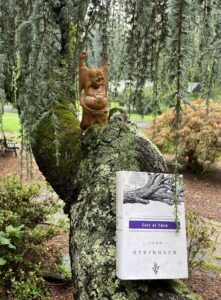
John Steinbeck’s 1952 epic, “East of Eden,” is described as “a classic – a powerful and vastly ambitious novel that is at once a family saga (telling the intertwined destines of two families – the Trasks and the Hamiltons) and a modern retelling of the Book of Genesis.” But does it still resonate in the Age of Trump?
The Trask boys are a modern day Cain and Able, and the head of the Hamilton family is aged and wise. On page 297 of the novel, the reader is invited to join Aron Trask and Samuel Hamilton for dinner. They are joined and served by Aron’s longtime Chinese servant, Lee.
As their meal is drawing to a close, Samuel asks Lee if he recalls a conversation they had shared nearly ten years back. Lee replies, “Yes, the story. I told you, Mr. Hamilton, that I was growing more Chinese…Do you remember when you read the sixteen verses, the fourth chapter of Genesis and we argued about them? Well, the story bit deeply into me and I went into word for word. The more I thought about the story the more profound it became to me. Then I compared the (three) translations we have – and they were fairly close. There was only one place that bothered me.”
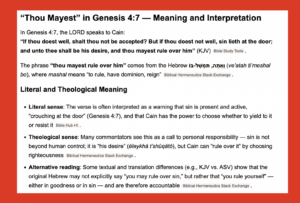
Lee then goes on to tell Adam and Samuel that he had engaged four wise elders from the Chinese community in a discussion of the Bible verse in the three different versions he had procured, with special focus on the original texts. Lee says, “After two years we felt that we could approach your sixteen verses in the fourth chapter of Genesis. My old gentlemen felt that these words were very important too – ‘Thou shalt’ and ‘Do thou’ and this was the gold for our mining ‘Thou mayest.’ Thou mayest rule over sin. The old gentlemen smiled and nodded and felt the years were well spent.”
“Samuel said, ‘Why is this word so important?’ Lee’s hand shook… ‘Don’t you see?’ he cried. The American Standard translation orders men to triumph over sin, and you can call sin ignorance. The King James translation makes a promise in ‘Thou shalt,’ meaning that men surely triumph over sin. But the Hebrew word, the word timsbel – ‘Thou mayest’ – that gives a choice. It might be the most important word in the world. That says the way is open.That throws it right back on a man. For if ‘Thou mayest‘ – it is true that ‘Thou mayest not.’ Don’t you see?”
“Samuel responded, ‘Yes, I do see.’ But do you believe this is divine law. Why do you feel its importance?”
“‘Ah!’ said Lee. I’ve wanted to tell you this for a long time. I even anticipated your questions and am well prepared. Any writing which has influenced the thinking and the lives of innumerable people is importent. Now, there are millions in their sects and churches who feel the order, ‘Do thou,’ and throw their weight into obedience. And there are millions more who feel predestination ‘Thou shalt.’ Nothing they may do will interfere with what will be. But ‘Thou mayest’! Why that makes a man great, that gives him stature with the gods, for in Cain’s weakness and filth and his murder of his brother, he has still the great choice. He can choose his course and fight it through and win.” Lee’s voice was a chant of triumph.”
Adam said, “Do you believe that, Lee?”
“Yes I do. Yes, I do. It is easy out of laziness, out of weakness, to throw oneself into the lap of deity, saying, ‘I couldn’t help it. The way was set.’ But think of the glory of the choice! That makes a man a man. A cat has no choice, a bee must make honey. There’s no godliness there. And do you know, those old gentlemen who were sliding gently down to death are too interested now to die?”
“Adam (Trask) said ‘Do you mean the Chinese men believe the Old Testament?’”
Lee said, “These old men believe a true story, and they know a true story when they hear it.They are critics of truth. They know that these sixteen verses are a history of human kind in any age or culture or race. They do not believe a man writes fifteen and three-quarters of truth and tells a lie with one verb.”
________________________________________________________