Mike Magee
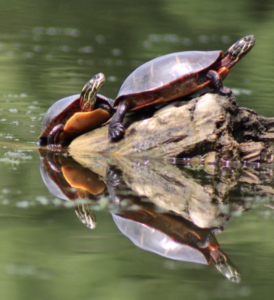
I have always had a fascination with turtles. Growing up on a northern New Jersey lake, with access to small boats and the freedom to explore, I learned early to spot them from a distance by the telltale reflection of the sun on their shells as they perched together on logs jutting out from the shore.
New Jersey is the home to at least 18 different varieties of turtles. The one I was most familiar with was the Eastern Painted Turtle, also known as Chrysemys pitta pita. It is the most common turtle in New Jersey, found in fresh water lakes, and marshes, and ponds where there are plenty of logs for basking in the sun. They are “painted” with distinctive yellow stripes on the head and neck and shells made vibrant with red and orange markings.
The recent algae controversy in our national non-reflecting Reflecting Pool, drew me back to my childhood friends, knowing they love to scavenge on aquatic plants and algae, nibbling away at dead organisms and helping clarify the water.
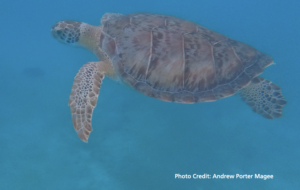
By some estimates, there are 356 recognized species of turtles and tortoises worldwide, contributing some 3% of all reptile species. This includes both land based and aquatic dwellers. Though I still encounter my favored painters on kayak runs in Connecticut waters, I have also embraced (with children and grandchildren) the sacred Green Sea Turtle (Chelonia mydas) in warm water beaches an hour south of Cancun, Mexico (one of the most important nesting grounds in the western Caribbean).
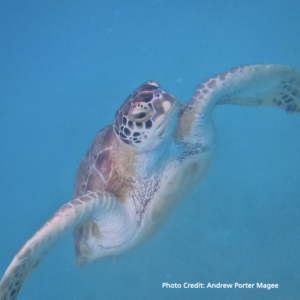
In Hawaii, this mythological giant is called Honu, and is far more than a simple sea turtle. It is a cultural and spiritual touchstone with roles like “guardian, navigator, and bringer of blessings.”
The Green Sea Turtle, or Honu, seems made for our troubled times. It is a symbolic guidance system for Americans seeking a pathway back to our “finer selves.” Rather than turn to “tech geniuses” like Peter Thiel for advice on living forever, better to model the patience, endurance, and steady peacefulness that allows these elegant life forms to often survive more than a century.
One of their cousins, the giant Seychelles tortoise, native to the Indian Ocean, recently celebrated his 194th birthday. He was born when Andrew Jackson was President, lived through 40 U.S. Presidents, and with a bit of good fortune, will outlive the current one. His name is “Jonathan” and he has lived on the governor’s estate on the island of Saint Helena since 1882 – that’s 41 years after Napoleon Bonaparte died in exile on this very same island, banished after his defeat in the Battle of Waterloo.
In mythology, the turtle has been a central metaphor that dates back over 3000 years, from the Shang oracle shells of ancient China, to its use to construct the first musical lyre in Greece, to Aesop’s tale of the tortoise that won the race by embracing “slow and steady.”
Turtles are endlessly fascinating. They are comfortable on land or water, move exceedingly fast (when you approach them basking on a log) or at a near stand-still pace (if undisturbed). They retract beneath their armored shell until their tormenters tire and leave them at peace. And their anatomy is so peculiar, it has been difficult to nail down their evolutionary parents.
Paleontologist Spencer G. Lucas says simply “turtles are just so bizarre.” A recent report suggests common parentage with birds, crocodiles, pterosaurs and dinosaurs. And what about that famous shell, and retractable head and extremities? That appears the product of 40 million years of slow adaptation. Specifically, “unusually wide ribs” fused to form a shell, and changes in vertebrae and internal organs allowed them to retreat at will.
But how the turtle became the turtle isn’t really the point. The Dalai Lama famously wrote “I learn as much from a turtle as from a religious text.” And Dr. Seuss added “And the turtles, of course…all the turtles are free, as turtles and, maybe, all creatures should be.”


4 replies on “Making Peace With The Turtles”
Mike, I continue to marvel at and enjoy your blogs, and the last two cause me to write. Remembering that you sent me a pre publication copy of Code Blue I had forgotten “As He died to make men holy let us die to make men free.” Brings tears to my eyes too.
And your essay and lessons about turtles will become food for my lessons for our grandkids. We see and cherish the huge Honu on the sands of Hawaiian Islands as our whole family will again this Christmas.
Thanks, and keep surprising us with your variety of lessons!
Dan Ostergaard
Many thanks, Dan. So nice to hear your voice. Remembering with fondness time spent with you and Doug in support of the AAFP. All the best to you and your family.
Yes, Mike, I echo Dan’s comments about the insights and poignant observations about politics, policy, and the life experience that you share, which add positivity and a sense of purpose to my own experience. Thank you for enriching our lives. -Jack
Many thanks, Jack! The profession and society are better for your remarkable caring touch! Best to you and yours! Mike