“Some Like It Hot.” – An Old Disease Arrives Anew.
Posted on | October 25, 2023 | 2 Comments
Mike Magee
Naomi Orestes PhD, Professor of the History of Science at Harvard, didn’t mince words as she placed our predicament in context when she said, “If you know your Greek tragedies you know power, hubris, and tragedy go hand in hand. If we don’t address the harmful aspects of human activities, most obviously disruptive climate change, we are headed for tragedy.”
At the time, as a member of the Anthropocene Workgroup, she and a group of international climate scientists were focused on defining and measuring nine “planetary boundaries,” environmental indicators of planetary health. At the top of the list was Climate Change because, one way or another, it negatively impacts the other eight measures.
Not the least of these “human perturbations” is the effect of global warming on access to clean, safe water, and the impact of violent weather cycles and rising sea levels on concentrated urban populations along coastal waters.
A less recognized, but historically well documented threat, is exposure to migrating vectors of disease as they contact unprepared human populations beyond their traditional camping grounds. The threat of avian flu among migratory birds has been well covered. Equally, over the past decade, North America has seen a range of novel infections, especially along our southern borders, from dengue, to chikungunya, to Zika.
The southern United States and its coastal populations are firmly in the cross-hairs. Their seas are rising at an alarming rate, and fouling fresh water supply with invasive sea water. Their soaring temperatures are only exceeded by record setting atmospheric river rainfalls and flooding events, and their “extreme poverty throughout Texas and the Gulf Coast states, where inadequate or low-quality housing, absent or broken window screens, and a pervasive dumping of tires in poor neighborhoods,” as reported in this weeks New England Journal of Medicine, assures a reemergence of one of this countries most significant, but now long forgotten killer diseases.
In 1853, the disease killed 11,000 in New Orleans, some 10% of the population. Twenty-five years later, it overwhelmed Mississippi Valley cities killing 20,000. Its latest major foray in the United States was in 1905 with 1000 deaths. Its’ absence over the past century is credited to public health and structural and engineering advances. But that was then, and this is now.
The disease is Yellow Fever, and red lights are blinking in a range of southern coastal cities from Galveston, TX, to Mobile, AL, to New Orleans, LA and Tampa, FL.. Experts say they may soon be in the same boat as Brazil was between 2016 and 2019 when it experienced a threefold increase in the historic prevalence of the disease among its population.
Public Health sleuths have uncovered that the 1878 epidemic in the Mississippi Valley was triggered by an El Nino spike the year prior. The warmer and wetter conditions are believed to have supported a large increase in Aedis aegypti mosquitos, the vector for the Yellow Fever virus.
Are we prepared? Recent experience in fighting Dengue fever in the southern states is not encouraging, with WHO chief scientist Jeremy Farrar warning that Dengue might soon “take off” absent better mosquito eradication and screening prevention. U.S. Public Health experts say a Dengue foothold is nearly secured and the disease is fast on its way to becoming endemic in southern coastal states.
As for Yellow Fever, there is an effective vaccine, but it is also associated with rare but serious side effects. Antivaccine activism post-Covid would be a significant barrier now say experts. Adding to the challenge, no Yellow Fever vaccine is currently available from the U.S. Strategic National Stockpile. Mosquito surveillance programs are currently marginal, and response capabilities for mass vaccination in affected areas are severely limited.
The Anthropocene Workgroup is fully aware of these human instigated crises. In the prior Holocene Epoch of 11,700, we prided ourselves with being able to co-exist with other lifeforms and in equilibrium with a healthy planet. But beginning in 1950, the new Anthropocene Epoch has aggressively chipped away at planetary health, disrupting stabilizing cycles, and critically raising the temperature and acidity of oceans that cover and buffer 70% of the planet.
The return of Aedes aegypti, and the Yellow Fever virus it carries, is a dramatic harbinger of additional challenges to come if we are unable to limit “human perturbations” of our planetary cycles.
Tags: anthropocene epoch > anthropocene working group > chikungunya > dengue > global warming > halocene epoch > Yellow Fever > Zika
Agents of Democracy
Posted on | October 19, 2023 | Comments Off on Agents of Democracy
Mike Magee
In the Age of “Doomscrolling,” Doctors and Nurses Need To Stay Focused On Their Primary Mission.
Exactly 1 year ago, mental health experts alerted the medical world to their version of an assessment scale for yet another new condition – “doomscrolling.”
As defined in the article, “Constant exposure to negative news on social media and news feeds could take the form of ‘doomscrolling’ which is commonly defined as a habit of scrolling through social media and news feeds where users obsessively seek for depressing and negative information.”
No one can deny a range of legitimate concerns. Faced with continued background noise from the pandemic, add global warming, renegade AI, and the Republican Congress. And now, the devastating attacks on Israel and growing instability in the Middle East. It is no wonder that we can’t turn off the Instagram feed.
With real challenges like these, our troubled world needs her doctors and nurses to stay focused more than ever on their primary professional missions – managing health and wellness, sickness and disease, fear and worry, and yes, now “doomscrolling.”
John J. Patrick PhD, in his book Understanding Democracy, lists the ideals of democracy to include “civility, honesty, charity, compassion, courage, loyalty, patriotism, and self restraint.” The 4.2 million registered nurses and 1 million doctors in America are agents of democracy.
Regrettably, they are already being drawn away from patients by three powerful forces.
- Corporate Dislocation – To assure maximum reimbursement, doctors and nurses are routinely asked to prioritize time and contact with data over time and access to patients.
- Health Technology and AI Substitution – Rather than engineering solutions to expand real-time patient contact, most innovations are further distancing patients from healthcare professionals.
- Legislative Intrusion – Complex medical decisions, long entrusted to the patient-health professional relationship to negotiate, are being transferred to ultra-conservative legislators.
We live under a constitutional and representative democracy, as do two-thirds of our fellow citizens in over 100 nations around the world. The health of these democracies varies widely. The case for democracy emphasizes its capacity to enhance dignity and self-worth, promote well-being, advance equal opportunity, protect equal rights, advance economic productivity, promote peace and order, resolve conflicts peacefully, hold rulers accountable, and achieve legitimacy through community based action.
One of the challenges of democracy is to find the right balance in pursuing “the common good” which has dual (and often competing) arms. One arm is communitarian well-being and the other, individual well-being. Blending personal and public interests is complex. In health, one might argue, this tension has led to our dual system – one, largely profit driven, interventional and science discovery based, and the other largely public, preventive and focused on communitarian public health.
Both nursing and medicine have embraced professionalism, and launched new graduates by voicing “oaths” or promises to themselves, their colleagues, and our society as a whole. These lists of promises or pledges, their language and priority ordering, helps reveal both the history and intent of these noble professions.
Of course, the most famous oath in Medicine is the Hippocratic Oath reaching back some 2000 years to Greece. In pledging to a grouping of ancient deities, it recognized that interventions should “do no harm,” and that confidentiality was paramount.
By 1964, this oath was sufficiently out of date that many medical schools embraced an updated version written by Louis Lasagna, MD. The oath includes a communitarian connector: “I will remember that I remain a member of society, with special obligations to all my fellow human beings, those sound of mind and body as well as the infirm.”
The Penn State College of Medicine’s Oath in 2022 offered a counter-balance by giving top billing to the patient, with the oath to the patients, not to Greek gods: “By all that I hold highest, I promise my patients competence, integrity, candor, personal commitment to their best interest, compassion, and absolute discretion, and confidentiality within the law.”
The Geneva based World Medical Association, in the shadow of the Nuremberg Trials, provided a list of pledges in their 1946 Declaration of Geneva in order of appearance including:
- the service of humanity
- patents first
- patient autonomy and dignity
- respect for human life
- absence of bias or prejudice on any basis
- commitment to patient privacy
- guided by professional conscience and dignity
- honor the noble traditions of the profession
- respect and gratitude to teachers, colleagues and students
- share knowledge to advance health care
- commit to personal health and well-being
- never violate human rights.
Nursing has also relied on professional Oaths. The first was the Nightingale Pledge, created in 1893 by the Farrand Training School for Nurses and named after Florence Nightingale. It is believed to be based on the Hippocratic Oath, and was modernized in 1935. In the 1950’s, the American Nurses Association (ANA), created a formal Code of Ethics, including Nursing’s 9 Provisions (or Pledges) committing to: compassion and respect, patient-focus, advocacy, active decision making, self-health, ethical environment, scholarly pursuit, collaborative teamwork, professional integrity and social justice.
As health professionals, we need to be laser focused during these troubled times on our patients. Doctors and nurses, day in and day out, by managing fear and worry, reinforcing community and family bonds, and championing hopefulness, guard against a true “doomsday scenario” – the destruction of our Democracy from within. The patient is our primary concern, and deserves our full professional attention.
Tags: declaration of geneva > doomscrolling > hippocratic oath > John J. Patrick > Louis Lasagna > nuremberg trials > patient-healthprofessional relationship > patient-physician relationship > penn state college of medicine > world medical association
Is Your University President An “Intentional Peacemaker?” This One Is!
Posted on | October 12, 2023 | 6 Comments
Mike Magee
Two days before Hamas launched its barbaric attack on Israel, a U.S. based university president delivered a Keynote Address at an International Peace Conference in South Korea. Here were his opening words:
“In the contemporary world that is somehow both entirely interconnected and increasingly divided, the need to develop peacemakers has never been more pronounced. As a university president, I feel especially responsible to fulfill this need – to develop peacemakers is as noble an endeavorer for our institution of higher learning as I can imagine. Colleges and universities are where young minds evolve, perspectives are broadened, ambitions are shaped. If these institutions are intentional about their work, they can create in the hearts and the minds of young people the building blocks for peace around the world, strong ethical foundations, intercultural understanding, radical empathy, and the skills to solve complex problems and make change. They have the power to shape the values, ambition, and intentions in the next generation of global leaders and citizens.”
“This university was designed with a mission in mind – to develop problem solvers, entrepreneurs, and wise leaders from around the globe and to weave them together as a community committed to a more peaceful, sustainable, and equitable future for all. We’ve created an institution where training global citizens isn’t an afterthought, but the foundation of our work. It’s at the heart of everything we do. Our students come to us from over 100 nations, are accepted based on talent and character, rather than economic background and status. So what does this look like for us? Developing global responsibility is a combination of global exposure, intercultural understanding, lessons in civil discourse, and proximity to a global community.”
Take a moment to view his whole address here: https://www.youtube.com/live/sIsDrWJLlcw?feature=shared&t=13374
And read an interview that followed in the Korean press here: https://koreajoongangdaily.joins.com/news/2023-10-05/national/kcampus/Universities-must-do-more-to-cultivate-futures-problem-solvers/1883894
How does your president, faculty and student body stack up to his when it comes to the intentional creation of “peacemakers?”
_____________________________________________________
Full Disclosure: The university president noted above is related to Mike Magee.
Tags: highly selective universities > innovative universities > intentional education > Kimdae Jung Peace Forum 2023 > Mike Magee PhD > peacemakers
Can An Intense Dialogue Between Science and Religion Be Fruitful?
Posted on | October 4, 2023 | 4 Comments
Mike Magee
By all accounts, they were mutually supportive. He was three years older and the chief scientific adviser to the world’s most powerful religious leader. The Scientific American called him “the greatest scientist of all time,” and not because he won the Nobel Prize in Chemistry a decade earlier for explaining the nuts and bolts of ozone formation. It was his blunt truthfulness and ecological advocacy that earned the organization’s respect.
Paul Crutzan is no longer alive. He died on February 4, 2021 in Mainz, Germany at the age of 87. What attracted the 86 year old “Green Pope” to Paul were three factors that were lauded at his death in the Proceedings of the National Academy of Sciences (PNAS) – “the disruptive advancement of science, the inspiring communication of science, and the responsible operationalization of science.”
It didn’t hurt that Crutzan was pleasant – or as the The Royal Society in its obituary simply described him: “a warm hearted person and a brilliant scientist.”
In 2015, he was Pope Francis’s right arm when the Catholic leader, who had purposefully chosen the name of the Patron Saint of Ecology as his own, was briefed on the Anthropocene Epoch. Crutzen had christened the label five years earlier to brand a post-human planet that was not faring well.
Crutzen was one of 74 scientists from 27 nations and Taiwan who formed the elite Pontifical Academy of Sciences in 2015. Those selected were a Who’s Who of the world’s scientific All-Stars including 14 Nobel recipients, and notables like Microbiologist Werner Arber, physicist Michael Heller, geneticist Beatrice Mintz, biochemist Maxine Singer, and astronomer Martin Rees.
On May 24, 2015, they delivered their climate conclusions to the Pope, face to face. The Pope heard these words, “We have a collection of experts from around the world who are concerned about climate change. The changes are already happening and getting worse, and the worst consequences will be felt by the world’s 3 billion poor people.”
The next month, with his release of the encyclical on the environment, Laudato Si’, Pope Francis began by embracing science, with these words, “I am well aware that in the areas of politics and philosophy there are those who firmly reject the idea of a Creator, or consider it irrelevant, and consequently dismiss as irrational the rich contribution which religions can make towards an integral ecology and the full development of humanity. Others view religions simply as a subculture to be tolerated. Nonetheless, science and religion, with their distinctive approaches to understanding reality, can enter into an intense dialogue fruitful for both.”
Further along, he celebrates scientific progress with these remarks, “We are the beneficiaries of two centuries of enormous waves of change: steam engines, railways, the telegraph, electricity, automobiles, aeroplanes, chemical industries, modern medicine, information technology and, more recently, the digital revolution, robotics, biotechnologies and nanotechnologies. It is right to rejoice in these advances and to be excited by the immense possibilities which they continue to open up before us”
But then comes the hammer: “Any technical solution which science claims to offer will be powerless to solve the serious problems of our world if humanity loses its compass, if we lose sight of the great motivations which make it possible for us to live in harmony, to make sacrifices and to treat others well.”
Laudato Si’ and the Pope’s personal intervention in climate deliberations in 2015 are widely credited for the successful December 12, 2015 draft Paris Agreement. The final draft was signed four months later by 126 parties at the UN Climate Change Conference (COP21).
Now eight years have passed, and Pope Francis has decided that “enough is enough.” This week he released a condensed update of the original 180-page Environmental Encyclical, now just a 12-page apostolic exhortation.
In the piece, titled Laudate Deum, Pope Francis was especially critical of the U.S. and other developed nations, writing, “If we consider that emissions per individual in the United States are about two times greater than those of individuals living in China, and about seven times greater than the average of the poorest countries, we can state that a broad change in the irresponsible lifestyle connected with the Western model would have a significant long-term impact.”
Paul Crutzen’s spirit quite obviously was still stirring in the aging Pontiff’s soul. He raised again the mischief that man had unleashed in triggering the unprecedented ecological Anthropocene Epoch, and suggested worse times lay ahead if humans do not course correct. Specifically he sees humankind, now amplifying our mistakes with new AI technology, in dangerous territory. Specifically, to “increase human power beyond anything imaginable,” he says, is “a failure of conscience and responsibility.”
Those who know Pope Francis well, like fellow Jesuit priest David McCallum SJ say his brand of direct and confrontational “servant leadership” is just what the world needs at this moment. McCallum, is a professor of business and leadership, and expert on “restorative justice” at the Jesuit’s LeMoyne College in Syracuse, NY.
But for now he is based at the Vatican building a leadership curriculum that he says “is intended to create space for diverse people to participate in the church, listen to one another’s needs, and then discern a way forward together with the bishops – but not the bishops alone. In church terms, it is a call to synodality. In business terms, it would be like a flattening of the organization with less hierarchy, more teamwork, and more consultation.”
The Green Pope remains controversial, especially among deeply conservative Catholic bishops. But in him, admirers like McCallum see “a servant leader, (who) has to let go of immediate satisfactions, and might even have to embrace failure to accomplish a greater, long-term goal…people at times experience leadership in terms of sacrifice and a certain amount of loneliness. Those are two of aspects about leadership that can be a little bit challenging…This requires living, loving, and leading in a spirit of hope, with a sense of possibility for the future.”
We all need to hope and pray for his success.
We’re All In The Hot Seat Now.
Posted on | September 27, 2023 | 2 Comments
Mike Magee
It’s not that easy living in the “Big Easy” these days and co-existing with a world dominated by water concerns. When Times-Picayune gossip columnist Betty Guillaud (as the folklore goes) “coined New Orleans’ undisputed nickname” in the 1960’s, it was a lifestyle eponym meant to favorably contrast life in “The Big Easy” with hard living in “The Big Apple.”
That was well before August 23, 2004, when the levies failed to hold back the Gulf waters, and 1,392 souls perished leaving two names to last in infamy – Katrina and Brownie, of “Brownie, you’re doing a heck of a job” fame.
Now it’s not as if it’s been all smooth sailing for New York City and water. I mean, look at the history. When the British overran the Dutch in 1667, one of the first priorities was to dig the first public well and include a marvelous technologic advancement – a hand pump. That was in front of an old fort at Bowling Green, near Battery Park.
But by the early 1700s, the absence of a sewage system and saltwater intrusion from the Hudson and East Rivers, plus a crushing population explosion, had overwhelmed the clean water supply. The solution – temporary at best – haul in fresh groundwater, in limited quantities, from Brooklyn.
It was hard to tell in that century what was worse, the regular cholera outbreaks that claimed 3,500 lives in one single year, or the catastrophic fires burning without response like the one that destroyed a quarter of the city structures in 1776. So much for Independence Day celebrations.
The city’s response was to form a regulatory and operational agency, the Manhattan Company, under one Aaron Burr, to build out infrastructure with public funds. Excess funds were used to start a bank, whose name may be familiar to you – the Chase Manhattan Bank. As you might imagine, the leaders of the bank were better at making money than providing citizens with clean safe water.
But by 1837, with disease rampant and supplies dwindling, the city went all in on a technologic solution. With the help of 4000 immigrants beginning in 1837, the city built a dam six miles above the link between the Croton and Hudson Rivers, creating a five mile reservoir on 400 acres containing 660 million gallons of water. As the water collected, they also build the 41 mile Old Croton Aqueduct from the reservoir to the Great Lawn in Central Park, gravity driven, falling 1/4 inch every 100 feet. Just five years later, on July 4, 1842, the first drops arrived accompanied by fireworks.
Nowadays, water engineers constantly test and repair a system that now delivers 3.8 billion liters of drinking water to over 9 million New Yorkers each day. They also work to structurally address, in this age of global warming, encroaching salt water intrusion on the city’s shores. But if they are ever tempted to feel sorry for themselves, or utter the words, “It’s not easy,” they need only turn their gazes southwest to “The Big Easy.”
Let’s begin in Plaquemines Parish on the southern edge of the state. An intense and prolonged drought and massive evaporation during a long hot summer have promoted saltwater intrusion of the Mississippi River, and led to drinking water advisories since June forcing the state to provide bottled water to residents of the parish. There’s not much room for error where the Mississippi meets the Gulf. Chronic dredging of the river has left the mouth below sea level. Add to this that the river’s flow is down to 130,000 cubic feet per second, close to the lowest flow ever recorded.
The salt water is on the move north, detected now 66 miles upriver. Professor Mark Davis at Tulane’s Center for Environmental Law has been raising the alarm for several months. He says, “The amount of river it takes to push the Gulf of Mexico back and keep economies going needs to be appreciated, not just along the river, but nationally. This river does not have lots of water to share. The power of the river is what keeps salt water out,”
Up a ways, at West Feliciana Parish, a sandbar became so obstructive to the river on July 21 that tugboats have been required to allow barges to negotiate the narrowing pass. The “salt water wedge”, as it is termed, has now led Gov. John Bel Edwards to ask for a federal emergency declaration. The encroaching sea water not only fouls drinking water, but also destroys piping infrastructure due to its corrosive effects, and the raised salinity levels undermine the effectiveness of water treatment plants. It also harms crops and sickens live stock.
The dense “saltwater wedge” travels below fresh water above. This is the basis of the Army Corps of Engineers temporary solution – a strategically placed underwater levee anchored to the rivers bottom to obstruct upward advancing sea water. But the continued drought means the levee will be breached in days, not months. A second temporizer is to add up to 36 million gallons of fresh water a day to water treatment plants to dilute the briny water influx and allow the facilities to work effectively.
Pulitzer Prize winning social philosopher, Philip Kennicott, offers scant reassurance in a comprehensive review of how “the dark future of climate change” has undermined “the dream of air conditioning.” Chuck full of unintended consequences, he disturbingly reminds his readers that “Making internal spaces cooler for humans means making external environments hotter for all living things…” Drawing on images of Mars colonies that are “dependent on perpetual sources of oxygen and water,” he dares to “remind us of our frailty…as the danger zone for excess heat creeps into once clement zones, (and) the air conditioner joins the furnace as an essential system for ever more people.”
Kennicott’s closing line uncomfortably mirrors those of the Army Corps of Engineers and Governor John Bel Edwards. And whether you’re dealing with “saltwater wedges” in “The Big Easy”, or Canadian fire-driven, orange skies in “The Big Apple,” citizens everywhere best heed his warning that we’re in hot water now.
He writes, “We want to live beyond or without weather, because the weather we made is killing us.”
Tags: Army Corp of Engineers > Big Apple > Big Easy > environment > global warming > Gov. John Bel Edwards > Hurricane Katrina > Louisiana > Michael Brown > Mississippi River > Phillip Kennicott > salt water wedge
Super-Human Poison Ivy Is On The Move. Why?
Posted on | September 19, 2023 | Comments Off on Super-Human Poison Ivy Is On The Move. Why?
Mike Magee
Connecticut loves its’ trees. And no town in Connecticut loves its’ trees more than West Hartford, CT. The town’s borders include an elaborate interconnected reservoir system that does double duty as a focal point for a wide range of nature paths for walkers, runners and cyclists.
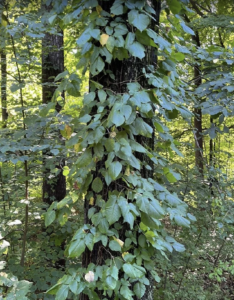
While walking one path yesterday, I came across the tree above with a massive upward advancing vine. My “PictureThis” app took no time to identify the plant. To my surprise, it was Toxicodendron radicans, known commonly as Poison Ivy.
The description didn’t pull punches. It read, “In pop culture, poison ivy is a symbol of an obnoxious weed because, despite its unthreatening looks, it gives a highly unpleasant contact rash to the unfortunate person who touches it.”
Its’ pain and itch inducing chemical oil covers every inch of the plant, and is toxic to 80% of humans. It was discovered by Japanese chemist Rikō Majima in the lacquer tree and named urushiol (Japanese for lacquer) in 1922. It is a derivative of catechol, an organic compound with the molecular formula C₆H₆O₂.
But the giant vine this week was nothing like the creeping little three leaf plant most children have been taught to avoid. This was a giant – a very different aggressor worth investigating. Its leaves were impossibly large and its vine straight and thick, and its vitality unhampered by a need to support elaborate roots or bark.
Others have noticed it too including “Pesky Pete” who has made a good living removing the invader from properties in Massachusetts and southern New Hampshire. And recently business has been booming. This is because the plant, which up to this year has never appeared in the region before May 10th, suddenly appeared this year on April 23rd.
This was no surprise to Bill Schlesinger, resident of Maine and Durham, NC. Officially, he is “William H. Schlesinger … one of the nation’s leading ecologists and earth scientists …a member of the National Academy of Sciences, …has served as dean of the Nicholas School of the Environment at Duke…”
Turns out Bill was in the lead on a six year project termed the “Duke University Free-Air CO2 Enrichment Experiment” between 2000 and 2006 when the results were published. They had been following tree declines in the Duke Forest where predatory vines had played a major role. They decided to encircle and isolate six giant forest plots and pump them full of CO2, and then catalogue the effects.
Their 2006 publication revealed that:
- CO2 enrichment increased T. radicans photosynthesis by 77%
- Increased the efficiency of plant water usage by 51%
- Stimulated the growth of poison ivy during the five growing seasons ambient plants
- Annual growth increase of 149% in elevated CO2 compared to ambient plants.
- Notably larger than the 31% average increase in biomass observed for woody plants
Poison Ivy was the fastest grower of them all in the experimental CO2 forests. Bill’s collaborator, Jacqueline E. Mohan, carried the work further as head of the Harvard Forest project in Massachusetts. They reported out results, not only on CO2 soil, but also warmed soil. They heated the upper layer of soil by 9 degrees. Her response to the findings was surprisingly down-to-earth. She said, “My heavens to Betsy, it’s taking off. Poison ivy takes off more than any tree species, more than any shrub species.”
Mohan and coworkers made it clear at the time that this was not great news for 8 out of 10 Americans who are sensitive to poison ivy. Not only did global warming and carbon footprints accelerate growth in the plant by 70% in its leaf size and biomass, but additional experiments revealed that these environmental enablers increased the amount of urushiol in the plant
As Duke was building those first towers to isolate their experimental forests in 2000, the International Geosphere-Biosphere Program was holding its annual meeting in Mexico. A Working Group subsequently focused on defining planetary boundaries (PB) that would assure both planetary and human health.
Nine years later, the group published “A Safe Operating Space For Humanity” in Nature. In it they proposed nine “planetary boundaries” to gauge “the continued development of human societies and the maintenance of the Earth system(ES) in a resilient and accommodating state.” In their view, measuring and ongoing monitoring of these boundaries would provide “a science-based analysis of the risk of human perturbations” that might “destabilize the ES on a planetary scale.” The work was updated in 2015.
The first Planetary Boundary listed was Global Warming with two measures, atmospheric CO2 and air, water, and soil temperature. As for human perturbation, as the picture above well illustrates, you can add super-human poison ivy to the growing list of unintended consequences.
Tags: Bill Schlesinger > Duke University Free Air CO2 Enrichment Experiment > global warming > International Geosphere-Biosphere Program > Jacqueline Mohan > Pesky Pete > poison ivy > Rico Majima > Safe Operating Space for Humanity > Toxicodendron radicans
Aerobiology: The Air Is Alive – And Not In A Good Way!
Posted on | September 12, 2023 | 6 Comments
Mike Magee
When Paul Crutzen and his band of happy meteorologic warriors launched the Anthropocene Epoch in 2000, their guiding star was to create a “safe operating space” for humans on the planet Earth. In service of this goal, they identified nine “planetary boundaries” (measures of planetary health) as planning guideposts.
Number one, familiar to all, was Climate Change. It’s measure was atmospheric CO2 levels less than 350 ppm (parts per million). How are we doing on that? Well, by any measure, not too well. This week’s headlines tell us that 2023 has had more weather related death and destruction than ever before, and the CO2 measure for 2023 now sits at 416.5 ppm.
Of course, this is not news. In fact, you’d have to be living under a rock to be unaware of the causal relationship between burning fossil fuels, rising atmospheric CO2 and weather related catastrophic wind, rain, and flooding from Libya to Leominster, MA. But what may catch many off guard is the news of what is traveling on the wings of particulate matter (including rain drops) fanned by these agitated atmospheric currents.
Welcome to the world of Aerobiology – the “study of aerosols with a biological origin.” Crutzen’s team listed it by another term – “Atmospheric Aerosol Loading” – as the #9 Planetary Boundary (PB) in 2015. A few weeks ago, The Lancet shined an unwelcome light on the issue with data suggesting that wild winds laden with microbes hitching on particulate matter appear to play a role in spreading drug resistant bacteria and fungi around the globe.
The Institute of Environmental Geosciences, Grenoble Alpes University, published a comprehensive review of PB #9 in 2020 titled “Microbial Ecology of the Planetary Boundary Layer.” What were their findings?
A Definition: “Aerobiology is a growing research area that covers the study of aerosols of a biological origin (i.e., bioaerosols) suspended in the atmosphere, from the air that directly surrounds us (both indoors and outdoors) to space by going through the different atmospheric layers.”
An Unhealthy Brew: “Bioaerosols include plant debris, pollen, microorganisms (bacteria, fungi, viruses, protozoans, etc.) as well as biological secretions which are mainly emitted by natural (forests, oceans, deserts, etc.) and urbanized Earth surfaces (agricultural fields, waste water treatment plants, cities, etc.) at different emission rates.”
Disease Focus: “Airborne microorganisms, especially bacteria, archaea, and fungi, are of particular interest as they represent living and potentially metabolically active cells light enough to be lifted high in the atmosphere by upward airflow.”
High Flyers: “During extreme meteorological events such as volcano eruptions and dust storms, sand-dust associated microorganisms can be ejected tens of kilometers high in the atmosphere before landing back on the Earth’s surface thousands of kilometers away. Microorganisms from the Bacillus and Micrococcus genera are commonly recovered from the stratosphere.”
Low Flyers: Particulate matter also travels in the lowest atmospheric layer – the troposphere. In addition to transporting microbes, troposphere particulates play a role in “meteorologic processes such as cloud formation and precipitation, atmospheric chemistry, and air quality.”
Growing Concern: “The capacity of microorganisms to be transported through the air has raised concern about the role airborne microorganisms might play in public health with the potential dissemination of plant and human pathogens as well as allergens.”
Does What Goes Up Come Down?: “The vertical gradient in microbial concentration suggests that microbial cell fluxes might be upward in the atmosphere.” (moving upward into the stratosphere).
But not in weather like this: “Exceptions to the rule might occur during extreme meteorological events such as volcano eruptions, hurricanes, and sand dust storms. In the latter case, microorganisms associated to large particulate matter, such as macroscopic sand dust, could be lifted high in the troposphere, travel along global air masses over thousands of kilometers then settle back to the Earth’s surface due to gravity, precipitation, and atmospheric circulation.”
The air is alive: “Airborne microbial cells exist mainly as aggregates or attached to particulate matter (size range from less than one nanometer up to hundreds of micrometers like sand dust), while airborne fungi exist mainly as single spores. Microbial cells entering freely in the atmosphere can attach to existing particulate matter or other microbial cells. Conversely, particle-attached microbial cells can detach from their support in the air.”
Size matters: “15% of cultivable airborne bacterial cells were on particles <2.1 µm (size) and 25% on particles >7.2 µm, and that cultivable airborne fungal spores and cells were mainly distributed on particles between 1 and 3.2 µm (median-based values) on average in outdoor air.”
Travel time: “Within the planetary boundary layer, airborne microorganisms might have a residence time of a few days before returning to the Earth’s surface due to gravity or precipitation (model assuming that microbial cells behave like non biological aerosols). In the free troposphere, their residence time might be several days during which they might be transported over long distances.”
Tags: aerobiology > air quality > atmospheric aerosol loading > co2 > global warming > microbes in the air > Paul Crutzen > planetary boundaries > weather events

"Code Blue INDEX online"


Prospective Health Blog
BIOGRAPHY

NIH Precision Medicine
BIOGRAPHY

Health in 30
BIOGRAPHY

Larry's Letters
BIOGRAPHY

Precision Medicine, Euthanasia, Abortion, Communism, Trillions of Dollars, Losing Freedom, and Town Hall Mobs BIOGRAPHY

Yearning for Universal Coverage Is Not Universal
BIOGRAPHY

