The “Comstockery” of Justice Clarence Thomas
Posted on | November 3, 2022 | 2 Comments
Mike Magee
“When we think about the past, we think about history. When we think about the future, we think about science. Science builds upon the past, but also simultaneously denies it.” These are the words of Jim Secord, a Professor of History and Philosophy of Science at the University of Cambridge. His research and teaching are on the history of science from the late eighteenth century to the present, with a special focus on Darwinian evolution.
His perspective is especially relevant when it comes to the recent Dobbs decision. The history of this contemporary struggle is as clear as is the science disputed by modern day left and right. It began on March 7, 1844, with the birth of this man, Anthony Comstock, in New Canaan, Connecticut. Raised in a strict Christian home, his religiosity intensified during a two-year stint in the Union Army during the Civil War.
A member of the 17th Connecticut Infantry, he took great offense to the profanity and debauchery he witnessed in and among his fellow soldiers. With the strong support of church-based groups of the day, and as the self-proclaimed “weeder in God’s garden”, he sought out a purpose and found a political vehicle in New York City’s Young Men’s Christian Association, and parlayed that to a post as the United States Postal Inspector.
His overarching goal was to advance Victorian morality by stamping out smut, which by his definition included obscene literature, abortion, contraception, gambling, prostitution, and more. The political arm he created in 1873, The New York Society for the Suppression of Vice, was chartered by the New York state legislature, and included the twin mottos of “Morals, not Art and Literature” and “Books are feeders for brothels.”
Using local postal agents, his searches and seizures, whose subsequent sales were shared 50/50 with his own organization, bank rolled the lobbying of Congress necessary to pass the “Suppression of Trade in, and Circulation of, Obscene Literature and Articles of Immoral Use”, otherwise known as the Comstock Laws.
Pornography, contraceptive equipment, reproductive health literature, and books deemed risque’ or suggestive all fell into his crosshairs.
By his own account, prior to his untimely death on September 21, 1915, he had prosecuted 3600 defendants, seized 160 tons of obscene literature, enjoyed the active support of industry, the AMA, and the Catholic Church among others, and sparked equally restrictive and intrusive legislation in 24 states – one of those being Connecticut.
Along the way, he made powerful enemies. For example, in 1905 George Bernard Shaw, on hearing in London that his new play, “Man and Superman” had been removed from the New York Public Library, had this to say in a public letter published in the New York Times, “Dear Sir – Nobody outside of America is likely to be in the least surprised. Comstockery is the world’s standing joke at the expense of the United States. Europe likes to hear of such things. It confirms the deep-seated conviction of the Old World that America is a provincial place, a second-rate country-town civilization after all.”
It was not power but time that overtook Comstock. He died at age 71 in 1915, but his supporters fought on in an increasingly loosing battle throughout “the Roaring 20’s” and into the economic collapse of the nation, the Great Depression, and a looming war in Europe.
With World War II fast approaching, FDR and Justice Hughes weighed priorities and decided indecency was less of a threat to the country than venereal disease among the troops. The AMA lent its support as well, and drugstores responded to the laissez faire by stocking over 600 different “feminine hygiene” products.
But the final nail in the Comstock coffin was fittingly delivered in the crusader’s home state. The protagonist was Estelle Griswold, Executive Director of the Planned Parenthood League. Their first state office had opened in Hartford in 1935. In 1961, Griswold was arrested and fined $100 for providing contraceptives and birth control advice in their New Haven office.
That arrest led to a landmark suit in the Supreme Court with effects far beyond Comstock. On June 7, 1965, in a 7 to 2 decision, authored by Justice William O. Douglas, the Supreme Court issued a 7–2 decision and struck down Connecticut’s state law against contraceptives.
In the Majority Opinion, Douglas wrote: “Would we allow the police to search the sacred precincts of marital bedrooms for telltale signs of the use of contraceptives? The very idea is repulsive to the notions of privacy surrounding the marriage relationship. We deal with a right of privacy older than the Bill of Rights — older than our political parties, older than our school system.”
In justifying the decision, he introduced an astronomical term, penumbra – the partially shaded outer region of the shadow cast by an opaque object such as the Earth.
In Justice Douglas’s words, “The provisions of the Bill of Rights created ‘emanations’ of protection that created ‘penumbras’ within which rights could still be covered even if not explicitly enumerated in the Constitution.”
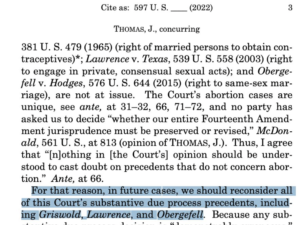
When the Dobbs decision that effectively reversed Roe v. Wade was handed down, Justice Clarence Thomas in a concurrence statement wrote, “…in future cases, we should reconsider all of this Court’s substantive due process precedents, including Griswold, Lawrence, and Obergefell.” These cases respectively deal with legal contraception, anti-sodomy laws, and same-sex marriage.
Of course, the elephant in the room, is self-evident. If “privacy” at the intersection of health and intimacy resided in the protective shield of “penumbra”, how about health itself? But in a Clarence Thomas world, historic precedent and scientific progress be damned. Bodily autonomy is a product of the state. Health is a luxury, doled out in small measure only to those who toe the party line. Justice Thomas is George Bernard Shaw’s modern day embodiment of “Comstockery.”
As Darwin himself wrote in On the Origin of the Species and Jim Secord recounted, “Nature, like a careful gardener, thus takes her seeds from a bed of a particular nature, and drops them in another equally fitted for them.” But for Donald Trump and his followers, the dropping in and dropping out involves legal gymnastics that provide cover, as they borrow from science and reverse the course of history, through sleight of hand and purposeful slip of phrase. And as they reverse science and distort history, what is unnatural becomes natural, and rights become privileges.
Tags: anthony comstock > clarence thomas > comstock laws > Dobbs > Griswold > Lawrence > Obergefell > Professor Jim Secord
If You Survived The Plague, Are You Destined For An Auto-Immune Disease?
Posted on | October 22, 2022 | Comments Off on If You Survived The Plague, Are You Destined For An Auto-Immune Disease?
Mike Magee
This Fall, I am teaching a 4-week course on “How Epidemics Have Shaped Our World” at the President’s College at the University of Hartford. It is, of course a timely topic, but also personally unnerving as we complete a third year under the shadow of Covid-19.
Where does one begin on a topic such as this? Yale historian, Frank M. Snowden, in his book “Epidemics and Society: From the Black Death to the Present”, made his intentions obvious. He would begin with the plaque. Why? His answer, “The word ‘plague’ will always be synonymous with ‘terror’”, and especially references:
Virulence: “It strikes rapidly, causing excruciating and degrading symptoms, and, if untreated, achieves a high case fatality rate (CFR)…of at least 50%.”
Speed: “Its progress through the body was terrifyingly swift. As a rule, the plague killed within days of the onset of symptoms, and sometimes more swiftly.”
Target: “It preferentially targeted men and women in the prime of life (and)…left in its wake vast numbers of orphans, widows and destitute families.”
Reaction: “…communities afflicted with plague responded with mass hysteria, violence, and religious revivals… people sought to assuage an angry god.”
Scapegoating: “Frequently, vigilantes hunted down foreigners and Jews and sought out witches and poisoners.”
One might also argue, as Snowden does, that the plague also launched the field of Public Health which included quarantines, penthouses, masking, and sanitary cordons. But knowledge of causality (Yesinia pests, passed along by common flea from ship rat to humans) and treatment (modern sanitary movement and modern antibiotics) was slow to reveal itself.
But that’s “ancient history.” Not so fast. Last week, Nature published a paper authored by Jennifer Klunk PhD and her associates from McMaster University’s Ancient DNA Centre focused on modern genes that they now believe owe their existence to the Black Plague’s human rampage nine centuries ago.
The Black Death is estimated to have killed 30% to 50% of Europeans between 1347 -1351. But DNA anthropologist, Hendrik Poinar, a colleague of Klunk’s, focused on one nearly forgotten graveyard in London, the East Smithfield graveyard. It was purchased by King Edward III as a plague pit for mass burials, accepting “guests” for a small moment in time between 1348-1349. Later survivors of the plague, who died of other causes, were buried on top of plague victims in 1350 and beyond. The dated samples of DNA included cadavers from before, during, and shortly after the plague event.
The hypothesis: “…this concentrated mass death event could have caused hugely selective pressure on the genetics of the individuals who survived, who would likely have passed down genes that allowed them to survive the plague.”
The findings:
- DNA samples were obtained from 318 cadavers in London and 198 cadavers in a Danish cohort. Burial position allowed investigators to pin time of death relative to the plague event. By comparing pre- and post-plague samples, the investigators were able to isolate 35 genes that were more prevalent in those that survived the plague. Cross-referencing with the Danish sampling, they whittled the list down to 4 genetic targets.
- One of the four variations was associated with the endoplasmic reticulum aminopeptidase 2 (ERAP2) gene which codes a protein whose purpose is to slice and dice invading viral and bacterial proteins, and post or display them on the surface of macrophages. These “warning flags” allow the protective macrophages to identify what invaders next to gobble up and destroy. The presence of the gene appears to have offered a 40% increased chance of surviving the plague.
- Modern day humans can have one, two, or no working copies of the ERAP2 gene. Investigators armed with human blood samples from all three varieties then tested them against the Yersinia pests bacteria. As expected, samples with immune cells having two working copies of the ERAP2 gene were most effective in killing Y. pestis.
The hitch:
But possessing this survival gene comes with one important downside. Modern day humans who have the two working copies of ERAP2 are also more likely to inappropriately attack their own living cells. Specifically, rates of Crohn’s Disease, Rheumatoid Arthritis, and Lupus are higher in this cohort than in those without the survival gene variant. The implications are obvious to all, and enough to bring Darwin back from the grave. As University of Arizona population geneticist said, “This is a truly impressive paper. The implications of the potential speed and power of natural selection in immune genes are wild.”
The protective, and potentially autoimmune causing variant, lives on in 45% of modern day Brits. Thus epidemics will continue to shape our world, raising difficult risk/benefit questions along the continuum of infectious disease, immunity, chronic inflammation, and modern day vaccine policy.
Promises Made – Promises Kept. Biden on “Obamacare.”
Posted on | October 17, 2022 | Comments Off on Promises Made – Promises Kept. Biden on “Obamacare.”
Mike Magee
As the saying goes, “History repeats!” This is especially true where politics are involved.
Consider for example the past three decades in health care. It is striking how many of the players in our nation’s health policy drama remain front and center. And that includes President Biden who recently commented on the 12th anniversary of the passage of the Affordable Care Act (Obamacare):
“The ACA delivered quality, affordable health coverage to more than 30 million Americans — giving families the freedom and confidence to pursue their dreams without the fear that one accident or illness would bankrupt them. This law is the reason we have protections for pre-existing conditions in America. It is why women can no longer be charged more simply because they are women. It reduced prescription drug costs for nearly 12 million seniors. It allows millions of Americans to get free preventive screenings, so they can catch cancer or heart disease early — saving countless lives. And it is the reason why parents can keep children on their insurance plans until they turn 26.”
The seeds for the ACA were planted when President Clinton assumed office in 1992, and put his wife Hillary Rodham Clinton, in charge of creating a government driven plan. Efforts to find a complex middle ground showed promise but ultimately failed. Seeing an opening, conservative Republicans declared in 1994 that it was “Dead on Arrival’ – and it was. Though there were some incremental expansions of coverage for vulnerable populations, like the Children’s Health Insurance Plan (CHIP) guided thru the Senate by Ted Kennedy as part of the 1997 Balanced Budget Act, the first signs of significant innovation and progress came later from Kennedy’s home state of Massachusetts.
Leading the charge in 2006 was the state’s Mormon, uber-capitalist, Republican Mitt Romney. With an eye toward a Presidential run, that would come six years later, he adopted the Heritage Foundation plan, complete with an “individual mandate”, and worked with the state’s Democratic legislature to enact the law. The mandate required all to be insured or pay the greater of $695 per adult and $347.50 per child per year or 2.5% of household income annually to the state.
When Barack Obama assumed the Presidency in 2008, the annual per capita health bill in the U.S. had reached nearly $8000 per year, twice the amount of any comparator developed nation in the world. Coming in, President Obama knew health care would be his signature legislation, and that he’d pay a steep price for it.
From the outset, three things were clear. First, a second run of the famous “Harry and Louise” ads that collapsed the Clinton health care effort in 1992 had to be headed off. So Obama met with each of the four health sectors – the AMA, the American Hospital Association (AHA), PhRMA, and the insurers – and made significant early concessions. No Medicare price negotiations or importation from Canada for PhRMA; lucrative Medicare Advantage plans for insurers; protected non-profit status and continued subsidies for hospitals for medical education and serving the underserved; and no changes in reimbursement for doctors.
Second, the template for what became the Affordable Care Act would be the Massachusetts universal health care initiative, a product of a Republican think tank and a Republican governor. Third, Republican Majority Leader Mitch McConnell would do everything within his power to block and destroy the legislation since he had already pledged that his single objective as Leader was to assure that Obama would be a single term President.
On March 23, 2010, President Obama signed the Affordable Care Act into law initiating a decade long war with Republicans on two fronts. First, in Congress, Republicans voted to repeal the law more than 60 times, all unsuccessfully. The most dramatic attempt came on July 28, 2017 when John McCain teamed up with fellow Republicans Lisa Murkowski and Susan Collins, and managed to appear in the chamber near death from brain cancer to provide a camera ready “thumbs down” to the Trump/McConnell effort.
Over this same decade, Republican-led states in parallel had attacked the law on Constitutional terms, chipping away at the statutes, without offering an alternative. Opponents termed the act “Obamacare” as if it were a pejorative label. The President turned that on his critics stating, “I have no problem with people saying Obama cares. I do care.”
“Repeal and Replace” became the rallying cry of Republicans. They didn’t succeed. But numerous challenges to the constitutionality of the legislation continue to this day.
In 2012, 26 Republican led states Attorney Generals joined in a suit to challenge the individual mandate which worked its way up to the Supreme Court. This was a component of the Massachusetts law designed to insure that all citizens and organizations would participate and contribute to even risk-sharing essential for insurance viability. Romney had tried to remove the clause from the Massachusetts bill but his veto was overridden by the Massachusetts legislature. In the federal bill the mandate was the “stick” to counterbalance the various “carrots” of premium subsidies.
The petition against the ACA mandate became the landmark case – National Federation of Independent Business v. Sebelius, 567 U.S. 519 (2012). The argument for repeal of the mandate was based on the fact that the administration had justified the mandate as constitutional based on the Article 1 Section 8 Commerce Clause or Necessary and Proper Clause. On June 28, 2012, Chief Justice Roberts disappointed fellow Republicans with a complex decision that split the difference.
As he stated in his closing: “The Affordable Care Act is constitutional in part and unconstitutional in part. The individual mandate cannot be upheld as an exercise of Congress’s power under the Commerce Clause. That Clause authorizes Congress to regulate interstate commerce, not to order individuals to engage in it. In this case, however, it is reasonable to construe what Congress has done as increasing taxes on those who have a certain amount of income, but choose to go without health insurance. Such legislation is within Congress’s power to tax.”
Roberts did support Republicans on a separate issue. The ACA had mandated that all states expand eligibility to Medicaid and agreed to subsidize 90% of the added expense. Republican states challenged the right of the federal government to impose those changes.
The Court’s ruling stated, “As for the Medicaid expansion, that portion of the Affordable Care Act violates the Constitution by threatening existing Medicaid funding. Congress has no authority to order the States to regulate according to its instructions. Congress may offer the States grants and require the States to comply with accompanying conditions, but the States must have a genuine choice whether to accept the offer.”
President Obama and Vice President Biden declared victory, praising the decision, and House Speaker Nancy Pelosi honored the lifelong campaign for universal health care by Ted Kennedy, who had died of brain cancer 10 months earlier, stating that he could now “rest.” Despite Republican pledges to fight on, as the New York Times wrote that day this ruling “may secure Obama’s place in history.”
President Biden echoed these same sentiments recently stating, “When I ran for President, I promised I would protect and build on Obamacare — and that’s exactly what my Administration has done. Thanks to the American Rescue Plan, ACA premiums are at an all-time low, while enrollment is at an all-time high…We’ve made tremendous progress, but our work is far from over.”
Need more specifics?
- “Thanks to the American Rescue Plan, ACA premiums are at an all-time low, while enrollment is at an all-time high.”
- “Four out of five Americans can find quality coverage for under $10 a month, and families are saving an average of $2,400 on their annual premiums.”
- “… increased enrollment to a record high 14.5 million Americans … including nearly 6 million who enrolled for the first time…”
- “…an additional 18.7 million low-income Americans now covered by Medicaid expansion.”
- “…the HealthCare.gov enrollment rate increasing by 26 percent for Hispanic Americans and 35 percent for Black Americans.”
Imagine’s Lyrics 51 Years Later – On National Indigenous Peoples Day.
Posted on | October 10, 2022 | 2 Comments
Mike Magee
John Lennon‘s Imagine was released as a single today 51 years ago. Many of the comments in response to last week’s Hcom question (“How civilized are we humans?”) focused on aspirations for hope, peace, and mutual understanding. Yesterday was the 8th national holiday on our calendar – originally Columbus Day, now Indigenous Peoples Day. At the core, the day is intended to recognize and celebrate our differences. In 2006, Jimmy Carter said, “In many countries around the world – my wife and I have traveled to about 125 different countries – you hear John Lennon’s song ‘Imagine’ used almost equally with national anthems.” In this spirit, take a few minutes to read and reflect on Lennon’s original words which suggest that, even in our complex diversity, there is much we share in common.
Imagine there’s no heaven
It’s easy if you try
No hell below us
Above us, only sky
Imagine all the people
Livin’ for today
Ah
Imagine there’s no countries
It isn’t hard to do
Nothing to kill or die for
And no religion, too
Imagine all the people
Livin’ life in peace
You
You may say I’m a dreamer
But I’m not the only one
I hope some day you’ll join us
And the world will be as one
Imagine no possessions
I wonder if you can
No need for greed or hunger
A brotherhood of man
Imagine all the people
Sharing all the world
You
You may say I’m a dreamer
But I’m not the only one
I hope someday you’ll join us
And the world will live as one
How Civilized Are We Humans?
Posted on | October 5, 2022 | 4 Comments
Mike Magee
“These are unprecedented times.”
This is a common refrain these days, from any citizen concerned about the American experiment’s democratic ideals.
Things like – welcoming shores, no one is above the law, stay out of people’s bedrooms, separation of church and state, play by the rules, fake news is just plain lying, don’t fall for the con job, stand up to bullies, treat everyone with the dignity they deserve, love one another, take reasonable risks, extend a helping hand, try to make your world a little bit better each day.
But I’ve been thinking, are we on a downward spiral really? Or has it always been this messy? Do we really think that we’ve suddenly bought a one-way ticket to “The Bad Place”, and there are no more good spots to land – places that would surprise us, with an unpredicted friendship, a moment of creative kindness, something to make you say, “Wow, I didn’t see that coming.”
I’m pretty sure I’m right that human societies, not the least of which, America, will never manage perfection. But is it (are we) still basically good? What does it mean to be human, and more specifically American?
In their 1980 book, “Fearfully and Wonderfully Made”, written by surgeon Paul Brand and Christian popular writer Philip Yancey, they included a story, attributed to an unidentified speech given by Margaret Mead some time in the past. While it has never been able to be validated, if the anthropologist really said it or not is probably inconsequential, because it rings true to so many.
Here’s one account of the full (non-verified) response:
“Years ago, anthropologist Margaret Mead was asked by a student what she considered to be the first sign of civilization in a culture. The student expected Mead to talk about fishhooks or clay pots or grinding stones.
But no. Mead said that the first sign of civilization in an ancient culture was a femur (thighbone) that had been broken and then healed. Mead explained that in the animal kingdom, if you break your leg, you die. You cannot run from danger, get to the river for a drink or hunt for food. You are meat for prowling beasts. No animal survives a broken leg long enough for the bone to heal.
A broken femur that has healed is evidence that someone has taken time to stay with the one who fell, has bound up the wound, has carried the person to safety and has tended the person through recovery. Helping someone else through difficulty is where civilization starts, Mead said.”
So let’s say this is true. One follow-up question I would have liked to ask Mead was, What was the helper’s motivation, do you think? Was it mutual survival? Was it engrained human kindness or empathy? Was it love? And do you think the the recipient of the care was surprised?
The capacity to be surprised, I think, is no small thing. It ties back to a bit of advice my father used to offer when I was young. “Guard against being too knowledgeable.” What he was advising (with limited success back then) was that “certainty,” directed at circumstances, people, or conditions (and especially in moments of anger or fear) can land you way off the mark and lead to regrets.
To embrace the capacity to be surprised in a good way requires that we maintain openness to the possibility that people and circumstances may not be exactly what we think. An excellent example of this was the behavior of Surgeon General C. Everett Koop in the face of the HIV/AIDS epidemic during the Reagan administration.
Koop at the time was a Don Quixote type character, a long time and aggressive pro-life campaigner and companion of uber-conservative minister, Francis Schaefer. When he was approached by Carl Anderson, a Catholic aide to North Carolina Senator Jesse Helms about accepting a nomination as Surgeon General, it seemed a sure thing and he promptly resigned his post as head of Pediatric Surgery at the University of Pennsylvania. After all, he not only had Helms support, but also Strom Thurmond and conservative Catholic Henry Hyde were firmly in his corner as well.
But what followed was nearly a year of bruising political combat as the AMA, the American Public Health Association (APHA), and a New York Times editorial on April 9, 1981 titled “Dr. Unqualified” attacked him with a vengeance
As he approached his 65th birthday in limbo, he quietly reached out to all sides, and finally in October, 1981, was permitted to plead his case before a Congressional committee that included Ted Kennedy and Henry Waxman. In that hearing, he stated to their surprise, “It is not my intent to use any government post as a pulpit for theology.”
For the next five years, he fought back against HHS Secretary Margaret Heckler, Reagan’s domestic policy chief ”family values” enforcer Gary Bauer, and Education Secretary Bill Bennett, to be allowed to address publicly the HIV/AIDS crisis. From 1983 to 1985, Koop was excluded from the Executive Task Force on AIDS. Finally, In October, 1986, Reagan first uttered the word, AIDS. By then, over 16,000 Americans were already dead.
Koop was finally given the green light to lead on a response to the crisis, and knew that public education had to be his primary tool. What became known, only years after, was that his primary friend and ally in the effort was the NIH’s Tony Fauci. Koop would consult with Fauci, day by day, as he formulated his drafts in secret. His 8-page pamphlet, titled “Understanding AIDS: A Message From The Surgeon General” arrived on 107 million doorsteps in America on May 26, 1988.
Senators Helms, Thurmond, Hyde and prominent conservative Christian televangelists attacked with a vengeance. He took the heat, stood up for America, and to the pleasant surprise of many who had earlier opposed him, stated “I’m the nation’s doctor, not the nation’s chaplain.”
Twenty years later, veteran ABC journalist, Dr. Timothy Johnson, had this to say about his friend: “He’s always willing to dialogue and listen to the other side. I think that’s a great strength.”
Truth and Trust in Science.
Posted on | September 29, 2022 | 6 Comments
Mike Magee
“The key is trust. It is when people feel totally alienated and isolated that the society breaks down. Telling the truth is what held society together.”
Those words were voiced sixteen years ago in Washington, D.C. It was October 17, 2006. The HHS/CDC sponsored workshop that day was titled “Pandemic Influenza – Past, Present, Future: Communicating Today Based on the Lessons from the 1918-1919 Influenza Pandemic.”
The speaker responsible for the quote above was writer/historian and Johns Hopkins School of Public Health adviser, John M. Barry. His opening quote from George Bernard Shaw set a somewhat pessimistic (and as we would learn 14 years later, justified) tone for the day:
“What we learn from history is that we do not learn anything from history.”
This was two years after the close of the 2002-2004 SARS epidemic with 8,469 cases and an 11% case fatality, and six years before MERS jumped from Egyptian camels to humans, infecting over 2,500 humans with a kill rate of 35% (858 known deaths.)
Specifically, John Barry was there that day in 2006 to share lessons learned from another epidemic, the 1918 Flu Epidemic which is now estimated to have killed roughly 700,000 Americans among a population that was roughly 1/4 our current size, with 2/3 of the deaths occurring over just a 14 week period from September through December, 1918.
The main point that Barry was trying to make that day focused on public communication during an epidemic, namely that “The truth shall set you free.”
Here were some of his 2006 reflections on 1918, a public health catastrophe at a time when the U.S. was focused on promoting strength not weakness during WW I.
“At best, they communicated half-truths, or even out-right lies. As terrifying as the disease was, the officials made it more terrifying by making little of it, and they often underplayed it. Local officials said things like ‘if normal precautions are taken, there is nothing to fear’…”
“Communication was rarely honest, because honesty would hurt morale.”
“There was a lot of cognitive dissonance. People heard from authorities and newspapers that everything was going fine, but at the same time, bodies were piling up.”
“Many times public health officials knew the truth but did not tell it. ..In many cases they were just plain lying.”
“The attitude of authorities was: ‘This isn’t happening, don’t worry about it.’”
Barry’s primary message that day was that communication breeds trust, and without trust, society breaks down. His words:
“The key is trust. It is when people feel totally alienated and isolated that the society breaks down. Telling the truth is what held society together.”
“The fear was so great that people were afraid to leave home or talk to one another. Everyone was holding their breath, almost afraid to breathe, for fear of getting sick.”
“False reassurance is the worst thing you can do. Don’t withhold information, because people will think you know more. Tell the truth— don’t manage the truth. If you don’t know something, say why you don’t know, and say what you need to do to know. Drown people with the truth, rather than withhold it.”
“The final lesson of 1918, a simple one yet one most difficult to execute, is that…those in authority must retain the public’s trust.”
But clearly that day, there was also a bit of a self-congratulatory air as well, an arrogance that today rings naive. John Barry says, “Today, I think, as opposed to back in 1918, we don’t have as much of a problem with misinformation…I want to emphasize that it is not likely that public health officials would tell outright lies.”
Twelve years later, on the 100th Anniversary of the 1918 Flu Epidemic, Barry re-released his New York Times best seller, “The Great Influenza: The Story of the Deadliest Pandemic in History”, a title that may not hold up as long as Covid-19 stubbornly holds on.
With Covid came Trump and his sycophants, and Barry’s theory (that mistrust can destroy societal order) was put to the test. In a 2020 interview at the University of Rochester, Barry holds strong to his messaging. “Those in authority must retain the public’s trust. The way to do that is to distort nothing, to put the best face on nothing, to try to manipulate no one.”
It is perhaps too easy to lay our current problems all on poor leadership at the top. Would that have been enough to deny the threat initially for months, and then spread false claims on fake cures, and then declare victory again and again prematurely? Was the public not somehow primed to accept such nonsense?
In the world I lived in for many decades, a profit driven world with vast rewards for scientific entrepreneurs, a world where progress up an integrated career ladder required cooperation, support for medical marketing on steroids, and bending the truth while turning a blind eye to errors of omission, truth was negotiable and trust was for the uninitiated.
A Red Painted Turtle On Rosh Hashanah.
Posted on | September 24, 2022 | Comments Off on A Red Painted Turtle On Rosh Hashanah.
Mike Magee

Tomorrow begins Rosh Hashanah, the Jewish New Year. This is the time when Jewish people ask God for forgiveness for their mistakes and errors over the past year and commit to learning from those mistakes as to not repeat them in the year ahead. The emphasis then is not on suffering, but on hope. And the remedies prescribed include “prayer, charity, and repentance” to be exercised in the 10-day period between the beginning of Rosh Hashanah and the end of Yom Kippur, the solemn fasting Day of Atonement, that this year extends from sunset on October 4 until after nightfall on October 5th.
The pinnacle of the liturgy, and the right notes of solemnity, according to many experts, is the Unetaneh Tokef, a poem focused on the judgement day for humanity, forecast as both “awesome and terrible.”
The poem recites out loud (in part) the questions we dare not ask.
How many shall pass away and how many shall be born,
Who shall live and who shall die,
Who shall reach the end of his days and who shall not,
Who shall perish by water and who by fire,
Who by sword and who by wild beast,
Who by famine and who by thirst,
Who by earthquake and who by plague,
Who by strangulation and who by stoning,
Who shall have rest and who shall wander,
Who shall be at peace and who shall be pursued,
Who shall be at rest and who shall be tormented,
Who shall be exalted and who shall be brought low,
Who shall become rich and who shall be impoverished.
But repentance, prayer and righteousness avert the severe decree.”
The Unetaneh Tokef entered the public culture for many as part of Leonard Cohen’s 1974 album, “New Skin for the Old Ceremony.” In that album, Cohen offers his version or take on the ancient and poetic prayer which resonates in an eerily familiar and contemporary way. Think an unpredictable pandemic and an utterly predictable Putin, forest fires and flooded streets, Sackleristic greed and our manmade opioid epidemic.
Cohen voices our despair in a single line: “And who shall I say is calling?”
Listen to these verses:
And who by fire, who by water
Who in the sunshine, who in the night time
Who by high ordeal, who by common trial
Who in your merry merry month of May
Who by very slow decay
And who shall I say is calling?
And who in her lonely slip, who by barbiturate
Who in these realms of love, who by something blunt
And who by avalanche, who by powder
Who for his greed, who for his hunger
And who shall I say is calling?
And who by brave assent, who by accident
Who in solitude, who in this mirror
Who by his lady’s command, who by his own hand
Who in mortal chains, who in power
And who shall I say is calling?
Yesterday, I took my 38 pound, 10 foot kayak, which fits inside my CRV, ten minutes away to a little pond in Avon, Ct. I had just read a piece on ecopsychology.
That’s the study of how nature, and humans immersion in it, benefits human health. That’s the raison d’être of an online magazine at Yale called Yale Environment 360. It’s a project published by Yale School of Environment which enjoys the support of the Ford Foundation, William Penn Foundation, and many others.
In 2020, they asked themselves “How long does it take to get a dose of nature high enough to make people say they feel healthy and have a strong sense of well-being?” After studying 20,000 people systematically, they had their answer. “Precisely 120 minutes” per week in a green space – whether a park, a small back yard, or the truly wild.
Unlike many health treatments, there were no significant disparities in the impact on feelings of healthiness these outings evoked. Ethnicity, occupation, poverty level, presence or absence of disability or chronic disease did not discriminate. The “calling” was ecumenical.
And yet each person’s journey, destination, and outcome is different. For me that day it was the the “calling” above, a red painted turtle (Chrysemys picta) on a log, similar to the many I had encountered as a young boy, exploring on a small lake, on my own, in northern New Jersey. It allowed me to quietly approach it, close enough to shoot the picture above, and share it (its vibrant colors, its sunshine reflection, its free spirit, and its full display of its own many ordeals) with you.
Happy Rosh Hashanah.

"Code Blue INDEX online"


Prospective Health Blog
BIOGRAPHY

NIH Precision Medicine
BIOGRAPHY

Health in 30
BIOGRAPHY

Larry's Letters
BIOGRAPHY

Precision Medicine, Euthanasia, Abortion, Communism, Trillions of Dollars, Losing Freedom, and Town Hall Mobs BIOGRAPHY

Yearning for Universal Coverage Is Not Universal
BIOGRAPHY

