NEJM Critique of US Medical Research – 1966 vs. 2016. A Deeply Conflicted System.
Posted on | June 6, 2016 | Comments Off on NEJM Critique of US Medical Research – 1966 vs. 2016. A Deeply Conflicted System.
Henry K. Beecher,MGH
Mike Magee
“Assessing the Gold Standard – Lessons from the History of RCTs” , in last week’s NEJM, provided useful historical perspective, but was intentional selective and treaded lightly on the darker side of America’s medical-industrial complex, and its conflicted role in human medical experimentation.
The most significant determinant that defined the direction of medical research in the post-WW II period was not the emergence of randomized controlled trials (the “gold standard”) but money. Over a short two decades, funding of medical research, flowing primarily through the federal government, exploded. Advances by 1950 to a total expenditure of $161 million seemed significant, but they were nothing compared to the $2.3 billion in funding that existed by 1968.(44) By then, financial incentives had solidified a deep and enduring bond forged by medical research leaders who traveled unimpeded from government to academia to corporate offices and back again.
There was a great deal of discussion about ethics in clinical research that accompanied those piles of cash, but, as it turned out, the words did not routinely match the deeds. In the wake of the Nuremberg Trials, the full extremes of Nazi medical experimentation had been revealed years earlier to the full glare of a horrified global audience. It was clear from the directives that followed that medical experimentation in humans could only be justified within certain well-defined boundaries. Ten rules or principles were laid out.
This was the determination of a worldwide Allied Tribunal that was conducted under the direction of U.S. judges and prosecutors, and which, in all respects, carried the criminal procedural standards of the U.S. government. And yet, another 25 years would pass before any of the ten agreed upon standards, cited in this code, were cited in a U.S. Court.
Legal scholars attribute this lapse to the professional biases of those in the lead of medical and pharmaceutical sectors in the 25 years following the war. As one prominent medical leader stated of the Nuremberg Code, “It was a good code for barbarians, but an unnecessary code for ordinary physician-scientists.”
The American medical leadership sought refuge in semantics. To them “therapeutic research” that benefited patients while expanding physician knowledge, was an entirely different kettle of fish than Nazi “non-therapeutic” research which meant clearly to do harm to the patients. American Medicine’s noble professionalism was adequate to ensure ethical research, most doctors believed. That was until June 16, 1966, when the New England Journal of Medicine published an article titled “Ethics and Clinical Research”.
The article was written by a highly-respected Harvard physician mentor of Lou Lasagna, Henry K. Beecher, who practiced at the prestigious Massachusetts General Hospital. Dr. Beecher’s opening paragraph said, “Human experimentation since World War II has created some difficult problems with the increasing employment of patients as experimental subjects when it must be apparent that they would not have been available if they had been truly aware of the uses that would be made of them. Evidence is at hand that many of the patients in the examples to follow never had the risk satisfactorily explained to them, and it seems obvious that further hundreds have not known that they were the subjects of an experiment although grave consequences have been suffered as a direct result of experiments described here. There is a belief prevalent in some sophisticated circles that attention to these matters would ‘block progress.’”
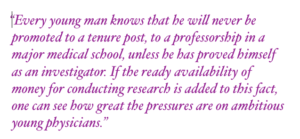
As for motivation for the ethical violations, he was about to catalogue in exquisite detail, he explained, “Since World War II the annual expenditure for research (in large part in man) in the Massachusetts General Hospital has increased a remarkable 17-fold. At the National Institutes of Health, the increase has been a gigantic 624-fold. This ‘national’ rate of increase is over 36 times that of the Massachusetts General Hospital…Taking into account the sound and increasing emphasis of recent years that experimentation in man must precede general application of new procedures in therapy, plus the great sums of money available, there is reason to fear that these requirements and these resources may be greater than the supply of responsible investigators. All this heightens the problems under discussion…Medical schools and university hospitals are increasingly dominated by investigators.”
From here, Beecher went on to share the review of 50 distinct American clinical studies with ethical violations. During this period, in and around the time of Beecher’s paper, other alarms were raised, only to be ignored. For example, there was a young physician from Detroit, named Irwin Schatz, who came across the study in a medical journal in 1964. It’s title was “The Tuskegee Study of Untreated Syphilis: 30 Years of Observation”. He couldn’t quite believe it and shot off a letter to the editor which read, “I am utterly astounded by the fact that physicians allow patients with a potentially fatal disease to remain untreated when effective therapy is available.”
Later records revealed that his unanswered letter had been read by one of the Public Health Service authors who wrote to her superior, “This is the first letter of this type we have received. I do not plan to answer this letter”. Schatz letter was attached. The study continued for another seven years.
What eventually catapulted the issue to the forefront was a New York Times article on July 26, 1972, titled “Syphilis Victims in U.S. Study Went Untreated for 40 Years.”(51) The whistle blower on what then remained an active human experiment was Peter Buxtan, an epidemiologist for the U.S. Public Health Service. He later said, “I didn’t want to believe it. This was the Public Health Service. We didn’t do things like that.”
In all, 399 infected patients were victimized before the plug was officially pulled on November 16, 1972 by President Nixon’s Assistant Secretary of Health, Merlin DuVal. The official apology for these crimes to humanity would have to wait another quarter century and were delivered by President Bill Clinton who said, “[t]he United States government did something that was wrong — deeply, profoundly, morally wrong.”
Congress did pass the 1974 National Research Act. It finally incorporated some of the protections recommended at Nuremberg. Voluntary consent was now required by law for all participants in U.S. medical research studies that received any federal funding. Study design had to be reviewed and pre-approved on ethical grounds by new institutional review boards (IRB’s) – a body of local professionals who would critique each proposed study and attest to its ethical construct. Finally, the Act established a National Commission for the Protection of Human Subjects of Biomedical Research that was charged to identify “the basic ethical principles which should underlie the conduct of biomedical and behavioral research involving human subjects.”
Case closed. Problem solved. Well, not exactly. In fact, the National Institute of Health has catalogued at least 11 milestone corrective legislative and rule setting events that have occurred since that time. And through it all, controversy and illegality has continued to swirl unabated. This has not only occurred in far off lands like Nigeria, but also on our own shores as well. Today’s problems are centered, not so much in the arena of treatment of research subjects, although there is always room for improvement, but rather in three derivative areas.
The first is data, or more specifically, how research data and study design is manipulated in pharmaceutical studies to exaggerate benefit and minimize risk in study results that lead to FDA approval.
The second area, not new really since it was the major concern that led to the Kefauver hearings over a half century ago, is the accuracy and purpose of the information that is regularly communicated, largely through marketing departments, to the American people and to their clinicians.
And finally, there is general agreement that the system is ripe with financial conflict of interest, heavily involving physician researchers and “thought leaders” who simultaneously direct academic medical departments, staff government drug review panels, and cash pay checks provided by the very companies whose potential products they are reviewing.
Tags: clininical research > Conflict of Interest > henry beecher > human experimentation > medical research > NEJM > the gold standard
Why the CDC, the WHO, and the IOC say “The Show Must Go On” in Brazil.
Posted on | May 30, 2016 | Comments Off on Why the CDC, the WHO, and the IOC say “The Show Must Go On” in Brazil.

Mike Magee
NYU Ethicist Arthur Caplan (formerly from Penn), is in the news again. This time, representing 149 other worldwide scientists who are advising the WHO and CDC to pressure the International Olympic Committee (IOC) to postpone this summer’s 2016 Summer Olympics due to begin on July 5th.
The 10,500 athletes from around the world (including 550 from the US), won’t be alone. About 600,000 out-of-town guests are expected to attend, coming from small and large countries around the globe. Over half the athletes will be women, all of child-bearing age. Caution would seem to support the letter writing scientists, one of whom recently commented in the Harvard Public Health Review that, “Rio is not on the fringes of the outbreak, but inside its heart”. And data from the government itself supports as much – with 26,000 individuals believed infected in Rio, the highest counts in all of Brazil. So what’s with the CDC and the WHO?
Their argument is that, even though a half million expected visitors (including 200,000 from the US) seems large, it is less than 2% of the current travel load to some 40 countries already on the Zika travel warning list. Such warnings already exist for 60 countries worldwide. Dumping the Olympics, they argue, will not halt the spread of this mosquito borne disease, now known to be transmissible sexually between humans. Furthermore, they note that the average monthly numbers traveling between the US and Brazil exceeds 235,000. So that cat is pretty much out of the bag. Finally, they note that it is winter in Brazil, and the mosquitos are less active. But the fact that Dengue Fever (a proxy for Zika) numbers are currently spiking in the Olympic Park neighborhood of Barre da Tijuca, at 6X the rate of last year, hasn’t helped that particular argument.
Testament to the spreadability of the Zika virus is the fact that there are already 1100 cases in the US and territories, including 300 pregnant women (122 in Puerto Rico alone). The official CDC advisory says to avoid traveling to high risk areas if pregnant or trying to become pregnant, and tells partners to use condoms or abstain from sex during the visit and for a few months after. That’s probably not going to work real well.
The quotes from the WHO and the CDC have been pretty definitive:
From the WHO: “There is no public health justification for postponing or cancelling the games.”
From the CDC Director:“We don’t see from a public health standpoint any reason to cancel the Olympics. There’s been some claims that if the Olympics happen, it’s going to disseminate the virus everywhere, it’s going to amplify it. Well, we looked at the numbers. The Olympics account for less than one quarter of 1 percent of all travel to Zika-affected areas.”
For now, US athletes are hanging tough. But others are nervous about their health and safety, including 11 senators who have asked the IOC to outline safety precautions that their infectious disease advisory committee has put in place. The response: real time information updates, a mosquito bit prevention kit, air-conditioning on site, and long-sleeved pants and shirts. The CDC is also poised to rapidly test any who present with symptoms of Zika, probably with blood and urine tests conducted on samples shipped back to the states.
The IOC, Brazil, and the rest of the world say the games must go on, irrespective of the objections of Dr. Caplan and his colleagues.
“Bob Trumpet’s” Wall: A Bridge Over Troubled Waters?
Posted on | May 20, 2016 | Comments Off on “Bob Trumpet’s” Wall: A Bridge Over Troubled Waters?

Mike Magee
“We are our geography’, as the saying goes. And nothing in current times illustrates this point more dramatically than Donald Trump’s proposed 1000 mile plus wall on our southern border. I won’t dwell on the oft repeated criticisms – the impossible logistics in radically reducing the numbers of 11 million immigrants (when we currently deport a maximum of 400,000 a year); the cost of such deportations pegged at $400 billion over 20 years; the cost of a 40 foot high, 10 foot deep (to avoid tunneling) wall of at least $26 billion, which doesn’t include ongoing maintenance; nor the shear embarrassment of living in a “free country” that chose to embrace such an embarrassing Soviet-style strategy (“Mr. Gorbackev, tear down this wall!”).
No. I will concentrate only on geography, most especially water. You see Mexico and the United States share more than a flow of citizens across our borders. We also share a flow of billions of gallons of water through the Rio Grande and Colorado Rivers, and their tributaries. As it turns out, our long standing treaties, which protect the flow, prohibit any kind of construction that would interfere with this flow – like a wall for example.
How this particular water flows, and who controls its use and distribution, has been a highly disputed issue for well over a century. But to the credit of both the U.S. and Mexico, we have managed to make peace, rather than war, over the sharing of this most vital resource. This has been especially noteworthy in recent years, as global warming induced droughts have decreased the flow. In fact, we just recently spent five years (2007 – 2012) successfully negotiating a treaty with Mexico that defines sharing into the future and agrees to the maintenance of dams, canals and water delivery systems derived from these two rivers.
Ken Salazar, 2012
Interior Secretary Ken Salazar said of the treaty in 2012, that the rivers, “in so many ways, makes us one people, and together we face the risk of reduced supplies in years ahead. More than ever, we are working together in times of drought as well as in times of abundance. We will cooperate to share, store and conserve water as needed.” Quite a different tone than the voice of the current Republican candidate for president, who my 5 year old grand-daughter, Luca, calls “Bob Trumpet”.
Let’s take a quick look at the geography of these two rivers. The Rio Grande (known in Mexico as the Rio Bravo del Norte) is nearly 2000 miles long, arising in the San Juan Mountains of southwest Colorado, and flowing south through New Mexico, a stone’s throw from Albuquerque, then turning southeast, forming the border between Texas and Mexico, bending hard at Big Bend National Park, and emptying into the Gulf of Mexico, in view of Brownsville, Texas and Matamoros, Mexico. Along this watery border, you’ll find many other paired towns like Laredo, Texas, and Nuevo Laredo, Mexico, and El Paso, Texas and Juárez, Mexico. Along the river, there are multiple dams and reservoirs, maintained and regulated by joint agreement, controlling for floods, and scarcity, and supporting vital agricultural needs on both sides of the river. Over four million Americans live and survive thanks to the Rio Grande watershed. The 2012 agreement sweetened the deal for the US, as drought made the prior sharing agreement problematic for our country.

If the Rio Grande joint stewardship is complex, the Colorado River system is monumental. This near 1500 mile waterway connects the Rockies in north central Colorado to the Gulf of California, or at least used to before drought and increased consumption dried up the last 60 miles of the descent. In 1922, we reached an agreement with seven US states and Mexico on the future allocation of the water. The Upper Basin (Wyoming, Colorado, Utah and New Mexico) received roughly 43% of the supply. The Lower Basin (Arizona, California and Nevada) was granted 49%. And Mexico was guaranteed 9%. While the allocations dating back to the 1944 treaty were based on a supply of roughly 21 billion cubic meters of water, 18 billion is the current estimate, with year to year variations of 6 billion to 25 billion.
The river’s behavior, and the storage and distribution of its water, and resultant hydroelectricity, involves the management of 20 major dams, including the 1936 Hoover Dam on the border of Nevada and Arizona, and resultant massive reservoirs like Lake Powell and Lake Mead. Internal water sharing is based on the principle of “useful purposing”, which helps explain why California agricultural fields receive 2/3’s of the supply, while golfing greens in Phoenix, Arizona may go wanting in the future.
The river supplies water to 1 in 8 Americans and irrigation for approximately 15% of all U.S. crops. But it also is a major supplier of municipal water to 17 million Americans in places like Los Angeles, San Diego, Las Vegas, Tucson, and Phoenix. As you might imagine, the management of this expensive and scarce resource is a delicate affair domestically, let alone adding Mexico to the mix. At the top of governance is the U.S. Bureau of Reclamation. But add to this separate state agencies, and then countess regional authorities.
All of which is to say that the 2012 agreement, which represented five complex years of negotiation, and at once acknowledged the need for careful management of an increasingly scarce resource, while committing ourselves and Mexico to a shared peaceful future – at least when it comes to water – strikes a wildly different tone then that bugled repeatedly by “Bob Trumpet”. Stated simply, we need to be building more bridges, and fewer walls.
Tags: colorado river > deportation > Donald Trump > immigration > rio grande river > trump wall > U.S. - Mexico water treaties > water scarcity
Healthy-Waters.org: Quick Quiz
Posted on | May 13, 2016 | Comments Off on Healthy-Waters.org: Quick Quiz

Boreal Forest Vulnerability: Part of the Healthy-Waters.org Story
Posted on | May 11, 2016 | 3 Comments
From "Drops of Life".

  Mike Magee
In 2005, in a piece addressing the health of the “planetary patient”, I wrote, “Water – it’s movement, forms, availability, and transportability – has directly shaped and continues to define the future of this planet and all of its inhabitants…As we have grown in numbers and in concentration; as we have built and infiltrated among, and at times, in opposition to other life forms, we have created future health challenges that must now be addressed.”
At the time, I saw water – its scarcity and unequal distribution and inaccessibility – as the most important planetary health issue of the day. I hit the road with a traveling show called “The Drops of Life”, a multimedia program prepared with the help of the Duarte Group which had produced Al Gore’s “An Inconvenient Truth”. What I discovered is that most health professionals considered the issue a low priority. Water was as inconvenient as global warming.
I began focusing on other issues, and “Healthy Waters” lay dormant. Then recently, I was in Syracuse, NY, to talk to 150 PA students of Dept. Chair Mary Springston and faculty at LeMoyne College. I spoke on leadership and change. In the address I touched on the case of three chemical engineering PhD students at Virginia Tech, who, with the support of their professor, uncovered and revealed the Flint, Michigan, poisoning of public waters with lead. Some months later, they published their story, citing the engineering code of ethics which pledges a commitment to societal responsibility, and to protecting individuals above all else.
After the address, over lunch, Dr. Beth Mitchell, the Department Chair of Biological Sciences, asked me what had become of the Healthy Waters movement (the site was down). I explained that I had tried, but there had been little traction. She gently suggested, in the wake of Flint, Michigan, that I might try again.
As I was preparing to relaunch the new site, President Obama visited Flint, just as air filled with smoke and carbon-laden soot was beginning to approach the Midwest from fires in Fort McMurray, in northern Alberta. The juxtaposition nicely illustrates the urgent need for each of us to be better informed on our planetary health and critical issues like water. Let me explain.
By now, we all know that the lead in Flint’s water leached out of ancient pipes, made vulnerable by an engineering mistake. Less known is that 2000 other water systems in the US currently have dangerous lead levels. Cause and effect are clear. The will and resources to rebuild ancient infrastructure is less visible. It seems part of our populace would prefer to build a wall.
The situation in Alberta, Canada, is more convoluted, but inter-connected with planetary health and water as well. A few facts:
1. Alberta, Canada, is part of a heavily forested area in the Northern Hemisphere known as the Boreal (Northern) Forest, a belt of evergreens just below the Arctic Circle which includes Alaska, Canada, Scandinavia and Russia. The forest is made up of mostly resin producing, cone-bearing trees
2. For two decades, scientists have been predicting large scale fires and loss due to drying trees caused by increased temperatures, early snow melt, and secondary insect infestations. Temperature rises are greater in this Northern hemisphere belt than anywhere else on Earth.
3. The Boreal Forest represents 1/3 of all tree cover on Earth, and its capacity to absorb carbon is enormous.
4. In the last three years, both Russia and Alaska have had record breaking forest fires. The fires secondary impact, the deposition of heat absorbing soot onto the Greenland ice sheet, has accelerated the sheet’s disintegration. If we lose it, sea levels will rise 20 feet.
5. These are also heavy mining regions. As with Fort McMurray, mining leads to settlements, and their inhabitants carry an increase risk of accidental forest fires. These outposts generally do not have adequate forest fire fighting equipment or personnel, nor adequate exit plans. In Fort McMurray, 90,000 inhabitants had to be evacuated on a single highway.
Scientists see in the Boreal Forest multiple layers of vulnerability. Loss of the forests eliminates a critical carbon sink, while also acutely releasing large amounts of carbon into the atmosphere. The soot itself can magnify surface warming. The mining interests pollute surface and ground water reserves, while raising the risk of human caused fires, without adequate infrastructure to manage the calamity.
In 2005, in addition to the focus on integrated water cycles, I addressed the Water Crisis, Water and Health, Water and Agriculture, Water and Industry, Water and Energy, Water and Cities, and Natural Water Disasters. My timing was off. Healthy-Waters.org is again live, and “Drops of Life” has been updated. Whether we are ready or not, what recent events dramatically demonstrate, these issues are urgent and demand every citizen’s attention.
Tags: boreal forest > Dr. Beth Mitchell > Dr. Mary Springston > flint > forest fires > fort McMurray > health-waters.org > LeMoyne College > oil sand > Russian forest fires > virginia tech
In 2016, Denial of Global Warming Persists.
Posted on | May 7, 2016 | Comments Off on In 2016, Denial of Global Warming Persists.

The science was clear in 2007. It hasn’t changed in the decade since. But deniers persist.
Iglehart and Thompson: Does the AMA Need “A Different Model of Advocacy”?
Posted on | May 3, 2016 | Comments Off on Iglehart and Thompson: Does the AMA Need “A Different Model of Advocacy”?
 John Iglehart and Jeff Thompson MD
The AMA’s vigorous opposition this week to the FDA’s consideration of mandating training for opioid prescribers to curb the current opioid epidemic (which the AMA’s liberal policies toward specialty designation and pharmaceutical underwriting helped create), called to mind the words in 2009 of Gundersen-Lutheran neonatologist and CEO, Jeff Thompson in an interview with John Iglehart. They said:
IGLEHART: “One thing that has always struck me about physicians, and I suppose I’m particularly sensitive to it having written for a medical journal, the New England Journal of Medicine, for many years, is that physicians are generally leading citizens in the communities where they practice. They are respected, they bring authority and credibility to their tasks as doctors. Yet when physicians have gathered in various collections, whether it’s the American Medical Association or countless other medical organizations, when they gather in Washington and try to harness their authority and respect, it just breaks down, and it mostly breaks down because the issues that they bring to Washington are largely economic and pertain to their incomes. This has always struck me as odd and perhaps presents a challenge for organized medicine to figure out a different model of advocacy that would not only serve their own interests but those of the larger community and society. Do you also see a disconnect here?”
THOMPSON: “That’s a great observation, John. Here’s my answer back to you in a question. Why is it that 85 or 90 percent of pediatricians belong to the American Academy of Pediatrics, but probably less than 15 percent of practicing physicians belong to the American Medical Association?… I have always been a member of the American Academy of Pediatrics for the very reason that you state, because I knew where their priorities were. The AMA by contrast has been so embarrassing at so many times, it’s why at my age and behind me, the percentage of people that have engaged and paid dues has been tiny. Time after time the AMA has screamed about their finances and so they have lost their credibility in Washington and with the public.”
Tags: ama > FDA mandated retraining of physicians > opioid epidemic > oxycontin > pharmaceuticals > physician prescribing practices > purduepharma

"Code Blue INDEX online"


Prospective Health Blog
BIOGRAPHY

NIH Precision Medicine
BIOGRAPHY

Health in 30
BIOGRAPHY

Larry's Letters
BIOGRAPHY

Precision Medicine, Euthanasia, Abortion, Communism, Trillions of Dollars, Losing Freedom, and Town Hall Mobs BIOGRAPHY

Yearning for Universal Coverage Is Not Universal
BIOGRAPHY

