Deplorable Conditions and “Deaths of Despair” Trap Trump Loyalists.
Posted on | March 24, 2017 | Comments Off on Deplorable Conditions and “Deaths of Despair” Trap Trump Loyalists.

Mike Magee
As the House leadership twists arms today, the noose is getting tighter by the minute around the necks of the most loyal Trump voting block – white males with only a high school education or less.
As the twisted deliberations over a deeply flawed bill progress, Brookings is hosting the Nobel Prize winning economist Angus Deaton whose latest survey results could not be more timely. His lead: Deaths of white males with no higher education continue to escalate. For those age 50 to 54, white deaths are now 30% higher than mortality rates of blacks in this age bracket.
Deaton, who released the first indicators of a reverse in historic life expectancy advances for whites in 2015, has now labeled the human losses as “deaths of despair.” These tragic outcomes, he believes, are the result of a basket of deplorable conditions that began to trap whites economically over the past two decades. Globalization and technology caught vulnerable whites by surprise – even though they were warned. As Deaton said, “The company man job has gone away for working-class people.”
As jobs disappeared, marriages declined, relationships became stormy, children were born out of wedlock, and individuals were increasingly socially isolated. In response, whites turned to alcohol and drugs, especially opioids. At the same time, owing to the absence of national health care insurance, they put off health care, and their burden of chronic disease including heart attacks, stokes, hypertension, pain syndromes, and mental health deterioration made a bad problem even worse.
For many, Trump spelled hope. But the formula he supports as we speak, will predictably worsen their deplorable state of affairs. As Rand’s labor market expert, James Smith, recently said, “The bad things that are going on in America do not appear to be going on in Western European countries, and that’s a big deal.” Those countries have a secure safety net and health services that the Republicans are busy dismantling.
According to Deaton, this will only get worse if Trump policy prevails. He says, “As these people move into old age, they’re going to be sick, and that has disastrous consequences for Medicare and Social Security policy… People may want to soothe the beast. They may do that with alcohol, they may do that with drugs, they may do that with food.”
Harvard professor David Cutler, appearing with Deaton at Brookings today, saw the Trump and Ryan solutions in stark terms.“Treat the fever by causing an even bigger fever,” were his words.
Tags: Angus Deaton > basket of deplorables > deplorable conditions > white life expectancy
Tonight’s Reading Material For Republican Legislators.
Posted on | March 23, 2017 | Comments Off on Tonight’s Reading Material For Republican Legislators.

Mike Magee
Since the Republicans have stalled today in their eight year pursuit to repeal Obamacare, perhaps they should take the night off, and relax by reading UNC professor Jonathan Oberlander’s NEJM advice on next steps.
Here are a few selections to whet your appetite:
Romney Care Origins: “The ACA is a conservative reform model embodying ideas previously supported by Republicans: consumer choice, private insurer competition, regulated marketplaces, tax credits to aid the uninsured, and individual responsibility to obtain insurance. If they repealed the entire ACA, Republicans would essentially be renouncing their own health care ideas.”
Regressive Redistribution: “The bill distinguishes itself from the ACA largely by its commitment to regressive redistribution: it would give wealthier Americans more money (mainly through sizable tax cuts) while reducing government support to help low-income Americans afford insurance.”
Low-Income Take A Hit: “Relative to the ACA, premium subsidies for the uninsured would decrease substantially, on average by 40% in 2020 and reaching 50% by 2026…The ACA’s subsidies to assist low-income persons with deductibles and copayments would be eliminated altogether.”
Seniors Suffer: “Because insurers could charge older persons higher premiums, they, too, would face much higher costs, with premiums for a lower-income 64-year-old expected to rise by about $13,000 in 2026.”
Medicaid -Forgetaboutit!: “Medicaid spending would fall by a staggering $880 billion during the next decade, resulting in a 25% cut by 2026.”
Morally Reprehensible: “Health policies represent more than the product of technical analysis, economic evaluation, and fiscal calculations — they also embody moral judgments and social priorities… Given this belief in self-reliance, faith in markets, and disregard for the poor, the GOP’s health bill is understandable — even if its moral logic is reprehensible.”
Politically Shaky: “The bill’s political logic is also shaky… In addition to unified Democratic and significant Republican opposition in Congress and among governors, key stakeholders — including the American Medical Association, the American Hospital Association, and the seniors advocacy group AARP — oppose the bill.”
Making It Worse: “The ACA’s insurance marketplaces have encountered significant challenges enrolling persons with modest incomes for whom, even with subsidies, insurance premiums and deductibles remain unaffordable. Instead of fixing these problems, the GOP bill, with its reduced subsidies, Medicaid funding cuts, and lower benefit standards, would substantially worsen them.”
Tags: failed republican health plan > john oberlander > NEJM > Republican health plan > Ryan plan > Tom Price plan > Trump plan
Making America Red Again?
Posted on | March 22, 2017 | Comments Off on Making America Red Again?
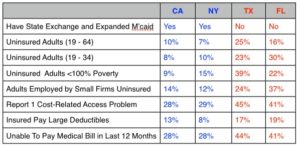
Commonwealth Fund Study, 2017
Price-Less: Make America Red Again.
Posted on | March 21, 2017 | Comments Off on Price-Less: Make America Red Again.

Mike Magee
In the weeks ahead, we will see how far backwards our health will slide under Republican leadership. In the President’s budget proposal this week, we see that he doesn’t care much for the EPA. Juxtapose that with this week’s BMJ study revealing a link between global warming and rising rates of diabetes. “Fake News?”
OK, then let’s try another. In September, 2008, feisty Republican candidate for president, Sarah Palin, took some heat for installing a tanning booth in the Governor’s Mansion in Alaska. Tanning beds were big business back then. There were 25,000 plus tanning salons in business at the time, with 160,000 employees and 30 million customers spending $2 billion a year.
Skin cancer rates were soaring. At the time, the AMA called for three simple and reasonable steps to bring about change. Number one, tanning booths should be off-limits to those 18 or younger. Number two, the FDA should conduct hearings to weigh-in on risk and the need for increased regulation. And number three, booths should come with a Surgeon General’s warning.
Responsible legislators like Carolyn B. Maloney, Democratic congresswoman from New York, advanced bills to help limit the carnage. At the time, she said, “New cigarette packs say smoking causes cancer. We don’t want to wait another 50 years to have labels that adequately warn people that tanning beds cause cancer.”
President Obama won the election, and signed the Affordable Care Act into law in 2010. As part of the law, our country levied a 10% tax on all tanning sessions, which will deliver $600 million in health supporting revenues over the next decade. This, along with growing educational initiatives and stigmatization of what some called “cancer beds”, caused over half of the nation’s tanning salons to close down. About 9,500 remain.
American Academy of Dermatology President Henry Lim says that 8% of the 419,000 cases of skin cancer each year are the result of tanning bed UV exposure. He says “The indoor tanning tax serves as a deterrent to discourage this dangerous activity, especially among young women.” But Secretary Tom Price, the candidate supported by both the AMA and AAMC, doesn’t believe much in taxation or regulation.
The Republican plan, set for a vote this week in the House, will cut $883 billion in taxes that were associated with funding the ACA. 40% of the recipient funds would go to the richest 1% in our country, worsening the income disparity which Republican Peggy Noonan says is the largest threat to our democracy. Corporations will thrive with breaks of $145 billion to health insurers, $25 billion to drug companies, and $25 billion to medical device companies. Nearly an equal amount in total, $880 billion, will be removed from the poor and vulnerable citizens covered by Medicaid.
The bill, if passed, will also drop the 10% tax on tanning bed sessions.
Tags: aamc > ama > American Academy of Dermatology > Henry Lim. > Paul Ryan > Republican health care bill > tanning beds > tax cuts > Tom Price > Trumpcare
Medicaid Caps and Paul Ryan’s “Good Old Days”.
Posted on | March 16, 2017 | Comments Off on Medicaid Caps and Paul Ryan’s “Good Old Days”.

Paul Ryan’s “A Better Way” is actually the same old way circa 1960 when Medicaid Caps were all the rage, with Welfare providing “medical vendor payments”. What did that look like?
- State spending was low: $12 billion nationwide in 2014 dollars covering <2% of citizens.
- Eligibility, coverage and utilization were tightly constrained.
- No care for children in 11 of 50 states.
- No hospital coverage, doctor coverage, medication coverage in 20 of 50 states.
- Decisions on coverage could be quite arbitrary: Kentucky – hospital coverage only for “life-threatening ” conditions, Montana – coverage for hospital only if vision threatened.
Caps were lifted in 1965. Medicaid programs are now required to cover certain programs.
“Federal mandates and open-ended federal cost sharing are meant to provide incentives for state spending, but states often balk at the large costs. Both state and federal budgets would benefit if each Medicaid recipient cost less. Unfortunately, a per capita cap on federal Medicaid spending is unlikely to achieve this aim. Rather than “modernize” Medicaid, the historical experience in the United States suggests per capita caps would simply shrink the program.”
Canada vs. U.S. Health Care: State Governance and Next Steps if Ryan Fails.
Posted on | March 15, 2017 | 2 Comments

Mike Magee
One of the most enduring myths that we Americans support when it comes to Canadian health care is that it is a nationally run, monolithic offering with little variability. That is patently false.
In fact, Canada’s official beginnings in health governance began in the province of Saskatchewan in 1946. For several decades they had been struggling to improve access to medical care, and then took their learnings and passed the Saskatchewan Hospitalization Act that provided universal coverage for hospital care to its citizens. Four years later, the province of Alberta followed suit with a public health plan that eventually covered medical services for 90% of its population.
In 1957, the national government upped the ante by offering to cover 50% of the cost of health care to provinces and territories that embraced their Hospital Insurance and Diagnostic Services Act, which eventually formed the pillars of the current Canada Health Act. By 1961, all ten provinces were aboard, and surprisingly controlled their own budgeting, priority setting, licensing, and provider participation within their territories. The national government set the mission and vision and agreed to pay part of the bill as well as administer the insurance details of the program. But the provinces did the rest.
In doing so, Canada traded control and systematic predictability for local support, involvement, and sustainability. What happened over the next few decades in terms of cost sharing, governance and variability well informs the current raging debate over replacement of Obamacare, and especially the fate of Medicaid in the U.S.
First the finances. To begin with, Canada never agreed to pay the entire health care bill for its citizens. In fact, national and provincial governments pay about 70% of the bill, and coverage is excluded for pharmaceuticals (although nationally negotiatated pricing puts their cost at roughly ½ to 2/3 of ours), dentistry, and optometry. The remaining 30% falls on Canadian’s shoulders, covered either by private supplemental plans or out of pocket.
Of the portion the government does pay, the original deal was that this would be a 50/50 split. But as in the U.S. after the institution of Medicare and Medicaid, costs rapidly escalated. Within a few years, the national government retreated to block grants, making these a line item in their budget. In the years that followed they first trimmed this line by 5% and later by 30%. The net effect was to alter the 50/50 bargain to 30/70, and finally to 15/85 today.
The individual provinces and territories then primarily control the decisions and most of the cost burden of their programs. There is considerable variability. In cost for example, Alberta pays roughly 20% more per capita than Quebec. In governance, some use province wide boards, and others rely on local hospital boards. And in outcomes, performance varies widely. Such is the price of a distributive system.
What is uniform however, is that all Canadians have coverage of the 70%, and this is provided through a single insurance plan administered by Canada itself. By doing this, Canada reinforces a national vision and basic access to services for all its citizens. As important, it eliminates some of the cost-shifting and payor-mix selection problems that have plagued the U.S. private insurer based model from the beginning. Stated plainly, we need charity care because: 1) Someone doesn’t have insurance, or/and 2) Someone has lousy insurance, or/and 3) doctors and hospital leave the poor and vulnerable in the lurch.
When President Obama chose the course he chose for the ACA, and Governor Romney chose the course he chose for Massachusetts, both were following, in part, the Canadian playbook. The starting point for both was, as in Saskatchewan, coverage. Broad participation by all would be necessary. The costs of the old and sick, needed to be counter-balanced by the contributions of the young and well. Both chose to use carrots and sticks to empower their mandates.
Massachusetts had the opportunity to adjust and fine-tune theirs. Obama, in the face of 8 years of determined and relentless opposition to kill his signature program, was never afforded the same opportunity. Specifically, 19 states not only didn’t stay neutral, they went nuclear. Many sat on their hands rather than work on state exchanges. 19 refused what became a 100/0 deal to cover cost of expansion of Medicaid. Remarkably, 20 million Americans still participated. Both legs of the program, as in Canada, embraced local control, and were provided a relatively free hand. For example, appeals for experimental models, as with Arkansas’s use of private insurers for Medicaid, were given a green light and proved successful, in part because it shielded and protected their poor and vulnerable citizens from discrimination by local providers.
But that was then and this is now. Paul Ryan’s plan, including caps on Medicaid, has run into stiff Republican head wins. This is not because the CBO (which they preemptively undermined) believes 24 million will ultimately be uncovered as they once again arrive in desperation on ED doorsteps across the nation (the good old days.) Rather its because analysts, with near uniformity, are predicting disaster – especially for the rural and elderly poor who figured prominently in their own and Trump’s election.
So what should we do?
As in Canada, we need to embrace local support, involvement, and sustainability. That means dealing the states in, but remaining united.
We do need a mandate. All citizens must contribute up to their means. This means fine-tuning the incentives so that people, especially young people, act.
We also need to help fund our health programs with graduated taxes on our most wealthy. Income disparity is now the greatest threat to our democracy. Supporting national health helps spread the wealth in more ways then one.
We need to build on the Medicaid success, and continue to support state waivers in the interest of openness and experimentation.
We should not move to block grants. That just passes the buck. Instead let’s work with state leaders to incentivize the creation of compassionate financial brakes on the system. We are all in this together, and we’ve proven that some states, if left in the darkness, will tolerate great suffering of their people rather than share resources or responsibility.
We need to be confident that many of the 19 state hold-outs will now choose to participate. If they do not, we need a back-up plan that does not depend on the largess of private insurers.
We need to call the private insurers bluff. They want to get out of the business. Fine. Get our best national and state public health financial people on the first plane to Canada, and figure out what they did to make Canada the top payer. If our private insurers wilt, we will have gained resources not lost them.
Tags: aca > canada health > Canadian Health Care > health reform > Medicaid > Obamacare > Paul Ryan > ryan plan trumpcare
Canada vs. U.S. Health Care: National Governance Reform – HHS, FDA, NIH, CDC.
Posted on | March 11, 2017 | 2 Comments

Mike Magee
As we have seen, America’s health care system – disintegrated, opaque and heavily conflicted – didn’t just happen. It is the result of thousands of conscious decisions over nearly a century. Choices made have tipped the scale toward intervention, technology, and medicalization at every turn. Peggy Noonan suggested this week that Paul Ryan’s bill will likely hyper-accelerate income disparity which she highlights as the most pressing threat to American democracy. Granted, that’s depressing.
But strangely enough and contrary to prevailing views, I remain optimistic for three reasons. The first is that we already expend more resources than necessary to lead the world in health performance. The silver lining of our remarkably inefficient delivery system is that we need not raise additional funds but simply reallocate them. After all, we expend just under $3 trillion a year on health care.
The second encouraging finding is that the pathway to solutions involves less complexity, not more. This is primarily an exercise in governance and editing. Our comparison with Canada reveals obvious course corrections that, until now, we have avoided. We currently lack a concise, long-term plan for a healthy America.
Finally, the MIC’s power and influence derives from secret collusion, limited checks and balances, and an integrated career ladder, all of which are amenable to policy corrections. Segregating research/discoveries from education and patient care will take us 90% of the way. Transparency and appropriate independent checks and balances should do the rest.
So let’s take a critical look at our current organizational assets – first national with state to follow.
Guilds and Unions:
Our nation is rich in guilds and unions that represent segments of our health care sector. They are interested foremost in advocating for their members financial needs and privileges. And there is nothing wrong with that. Foremost among the group are the AMA, ANA, AHA, PhRMA, AHIP and their distributive federation members. Add to these players multi-focused organizations like the AAMC which sees itself as the champion of post-Flexner quality medical education, but has yielded considerable high ground to its own Council on Teaching Hospitals and Health Systems which primarily seeks federal research and education dollars with few strings attached. Then there are the historic non-profits like the American Cancer Society and the American Heart Association, and the more recent collection of industry funded advocacy organizations.
These bodies need to play a critical participatory role in the provision of care. But it is important to recognize that they are neither independent nor an adequate substitute for an official national body to guide our health care future.
Governmental Entities:
America has a range of governmental bodies that have developed and evolved over the past half century. In general, they lack clarity, focus and long-term visions, and have long ago lost their independence. Rather than being planned deliberately, these bodies have “happened”, usually in response to crisis or politics.
The FDA’s three major evolutions – the 1906 Food and Drug Act, the 1938 Federal Food, Drug and Cosmetic Act, and the 1962 Kefauver-Harris Drug Amendments – were all in response to tragedies, namely tetanus-laced vaccines, childhood deaths from antifreeze tainted sulfonamide elixir, and thalidomide.
In the mid 20th century, free-marketers used “Red” baiting” and the Soviet Sputnik lead in space to bolster charges of a U.S. “drug lag”, and to justify green-lighting new drugs to the market. The late 1970’s recession offered another opening for industry intrusion. Today that push is on again, and yielding the same questionable results – for example, the use of “golden vouchers” to push generics with stratospheric prices. Through it all, the creation of new “diseases” and intrusive professional marketing of cures for these maladies has reinforced physicians and patients addiction to drugs and quick fixes.
The same players who have infiltrated the FDA do double time on Advisory Committees and Foundations at the NIH. The NIH, strangely enough, owes its odd existence as a conglomerate of “Institutes” to two middle-aged women philanthropists, Mary Lasker and Florence Mahoney who with the help of their fabulously wealthy PR/Media magnate husbands first staged a takeover of the American Cancer Society in the late ‘40’s, replacing its doctor Board members with New York City businessmen, and then pushed through an unprecedented federal infusion of cash into “research institutes” whose purposes matched their own parochial interests.
To pull off this feat, they engaged academicians, who in later decades would be called “thought leaders”. As the NIH grew, it remained true to form – medicalized and specialized – a career escalator.
Today you will find descendants of Mary and Florence on NIH Boards, funding colloquia, and attending government/industry/academia galas hosted by Research America! and Friends of Cancer Research. Genomics, Precision Medicine, and yet another “War on Cancer” are today’s darlings – again, fine. But from a national health governance standpoint, it would be a huge mistake to confuse scientific progress with human progress.
And then there is the Health and Human Services Department or HHS. Way back in 1798, our early leaders were worried about sick and disabled seamen. They passed an act and funded their care. That was the early beginnings of what became the U.S. Public Health Service. A half century later, President Lincoln launched the Bureau of Chemistry within the powerful Agriculture Department. As the new century approached, the focus was on immigrants and communicable diseases. We had the National Quarantine Act of 1878 and a one room research lab set up on Staten Island a decade later.
The Flexner medical education reforms would come and go before the single “National Institute of Health” name was placed on the Public Health Service’s Hygienic Laboratory in 1930. In the middle of the Great Depression in 1935, we passed the Social Security Act, and a decade later created the CDC. By 1953, it seemed time to consolidate. So Eisenhower created the Cabinet-level Health, Education, and Welfare (HEW) Department.
When a separate Department of Education was created in 1980, HEW became the Department of Health and Human Services. By then we had Head Start, Medicare, Medicaid, funding formulas for medical education, Community Health Programs, the National Health Services Corps, a National Cancer Act, and a Health Care Financing Administration (HCFA) to manage Medicare and Medicaid separate from Social Security. After that came AIDS, DRG’s, HMO’s, Organ Transplantation, Health Care Policy and Research (now AHRQ), Ryan White, Nutritional Labeling, the Human Genome Project, HIPAA, SCHIP, the Centers for Medicare and Medicaid (instead of HCFA), Medicare Part D…and on and on.
So you see what I mean. Canada planned its health system. Our’s just happened. Our major bodies now under HHS include the FDA, NIH, and CDC. They are non-transparent, MIC infiltrated, expansive, expensive enterprises. They scream for editing and focus.
Shuffling The Deck:
FDA needs to drop the gimmicks, focus on risk/benefit, and eliminate from its advisory and evaluative bodies any individuals with financial conflicts. Period. Do your job. Make sure our drugs are safe and effective. You are not an agent of industry. Attention Scott Gottlieb: Nowhere in your job description does it say “Make the American pharmaceutical, biotech and medical device industries great again!”
CDC needs to admit that there is more to creating a preventive health care system than adding an initial to your name. The Centers for Disease Control and Prevention is good at infectious disease, food borne pathogens, environmental health, occupational safety and health. Their Epidemic Intelligence Service is the best in the world. But agents in the transformation of U.S. health delivery from intervention to prevention, they are not. Programs like “winnable battles” which focuses on a few issues like obesity feel like add-on’s at best, and have yielded spotty results. Better to split off Prevention, bump it up, and give it some real resources and status.
NIH needs to own its “for-profit” status. You have become a national gold mine for innovative, transformational medical science and entrepreneurial marketable ideas. And that’s just fine. We gave you Bayh-Dole and along with collaborators in industry and academic medicine, you’ve mined it brilliantly. Keep up the good work!
But from now on your grants can only go to “for-profit” arms of the non-profits and will be taxable. That’s only fair since the recipients get to keep the profits and patents derived. Let’s be transparent here, and call your multi-sector collaboration what it is now – an engine of American industry. As speculative scientists, don’t complain that our checks and balances to protect the public from oversteps in pursuit of fame and fortune will treat you as business rather than health professionals.
With those new rules, we’ll trust that at least some of the valuable scientific progress you uncover will lead to broad human progress. Also, stop asking for more and more money. Your partners in the “for-profit” arms of academic medical centers and industry can help your budgeting and prioritizing better than the descendants of Mary Lasker.
HHS? You need to proceed on two fronts if the U.S. is to reach its’ health delivery potential. First, re-focus and re-form the CDC, NIH, and FDA as I’ve suggested above. Second, create a consensus national vision and guiding principles for our nation’s health, and appropriately organize and resource prevention. In this regard, Health Canada (their version of HHS), has a piece titled “Health Canada – a partner in health for all Canadians”. It’s worth a read.
And what are the states’ responsibilities? That’s next.
Tags: aamc > ACS > AHA > AHIP > ama > ANA > Bayh-Dole Act > CDC > Epidemic Intelligence Service > FDA > Health Canada. > HHS > NIH > Patient Advocacy Organizations > Peggy Noonan > PhRMA > preventive health care

"Code Blue INDEX online"


Prospective Health Blog
BIOGRAPHY

NIH Precision Medicine
BIOGRAPHY

Health in 30
BIOGRAPHY

Larry's Letters
BIOGRAPHY

Precision Medicine, Euthanasia, Abortion, Communism, Trillions of Dollars, Losing Freedom, and Town Hall Mobs BIOGRAPHY

Yearning for Universal Coverage Is Not Universal
BIOGRAPHY

