Channeling New Jersey’s “Bridgegate” – The Muslim Ban “Shock Event” Undermines Safety and Security in America.
Posted on | February 2, 2017 | 2 Comments
Heather Richardson, Boston College
Mike Magee
When Republicans waved through Tom Price this week, the AMA & AAMC got exactly what they desired. Business interests trumped their highest ideals. But as my father used to say, “Careful what you wish for.” In achieving their ethically compromised goal, they tied themselves to the Trump/ Bannon regime.
Their new business partners staged the Muslim Ban “shock event”, a national version of New Jersey’s “Bridgegate”. And the nation’s patients, for whom the House of Medicine continues to profess an undying commitment, absorbed a fountain of stress that did little for their overall health and well being.
Consider the measured assessment of Boston College historian and political scientist, Heather Cox Richardson, who this week exposed on Facebook the rationale behind the Muslim Ban and its methodology:
“I don’t like to talk about politics on Facebook– political history is my job, after all, and you are my friends– but there is an important non-partisan point to make today.
What Bannon is doing, most dramatically with last night’s ban on immigration from seven predominantly Muslim countries– is creating what is known as a “shock event.”
Such an event is unexpected and confusing and throws a society into chaos. People scramble to react to the event, usually along some fault line that those responsible for the event can widen by claiming that they alone know how to restore order.
When opponents speak out, the authors of the shock event call them enemies. As society reels and tempers run high, those responsible for the shock event perform a sleight of hand to achieve their real goal, a goal they know to be hugely unpopular, but from which everyone has been distracted as they fight over the initial event. There is no longer concerted opposition to the real goal; opposition divides along the partisan lines established by the shock event.
Last night’s Executive Order has all the hallmarks of a shock event. It was not reviewed by any governmental agencies or lawyers before it was released, and counterterrorism experts insist they did not ask for it. People charged with enforcing it got no instructions about how to do so. Courts immediately have declared parts of it unconstitutional, but border police in some airports are refusing to stop enforcing it.
Predictably, chaos has followed and tempers are hot.
My point today is this: unless you are the person setting it up, it is in no one’s interest to play the shock event game. It is designed explicitly to divide people who might otherwise come together so they cannot stand against something its authors think they won’t like.
I don’t know what Bannon is up to– although I have some guesses– but because I know Bannon’s ideas well, I am positive that there is not a single person whom I consider a friend on either side of the aisle– and my friends range pretty widely– who will benefit from whatever it is.
If the shock event strategy works, though, many of you will blame each other, rather than Bannon, for the fallout. And the country will have been tricked into accepting their real goal.
But because shock events destabilize a society, they can also be used positively. We do not have to respond along old fault lines. We could just as easily reorganize into a different pattern that threatens the people who sparked the event.
A successful shock event depends on speed and chaos because it requires knee-jerk reactions so that people divide along established lines. This, for example, is how Confederate leaders railroaded the initial southern states out of the Union.
If people realize they are being played, though, they can reach across old lines and reorganize to challenge the leaders who are pulling the strings. This was Lincoln’s strategy when he joined together Whigs, Democrats, Free-Soilers, anti-Nebraska voters, and nativists into the new Republican Party to stand against the Slave Power.
Five years before, such a coalition would have been unimaginable. Members of those groups agreed on very little other than that they wanted all Americans to have equal economic opportunity. Once they began to work together to promote a fair economic system, though, they found much common ground. They ended up rededicating the nation to a “government of the people, by the people, and for the people.”
Confederate leaders and Lincoln both knew about the political potential of a shock event. As we are in the midst of one, it seems worth noting that Lincoln seemed to have the better idea about how to use it.”
When Christie staff staged “Bridgegate”, the public outcry caught him and his aides in a serious undertow. Some are on their way to jail, and Christie, if he avoids prosecution, has forfeited his political career. With time, Trump and Bannon may suffer the same fate. For a profession that relies on public trust for their privileged position in society and the right to function with great latitude and independence, associating with this crowd seems a very bad political bet. If they have their way, vulnerable patients will soon be left out in the cold, and the public will remember these moves as clearly as they do the attempts to scuttle Medicare a half century ago.
Tags: aamc > ama > andrew gurman > Boston College > darrell kirch > Donald Trump > Heather Cox Richardson > James Madara > Jordan Cohen > Karen Fisher > muslim ban > Richard Deem > Shock Event > Stephen Bannon > Tom Price
AARP and the Commonwealth Fund Send Congress a Warning: We Oppose Dismantling Medicaid.
Posted on | January 31, 2017 | Comments Off on AARP and the Commonwealth Fund Send Congress a Warning: We Oppose Dismantling Medicaid.

If Tom Price and the Republican Congress plan to roll over health care, they are in for a fight. That is becoming increasingly clear. The latest messenger was the powerful AARP – not commenting (yet) on Medicare, but rather putting out opposition markers to the idea of Medicaid block grants.
The complete AARP statement is available HERE. Their salient point: “AARP opposes Medicaid block grants and per capita caps because we are concerned that such proposals will endanger the health, safety, and care of millions of individuals who depend on the essential services provided through Medicaid.”
Last month, the Commonwealth Fund released a study on Medicaid as well. In their summary they said:
“Medicaid plays a unique role in our health system, acting not only as insurance but as the nation’s most important health care financing safety net. Repeal legislation could eliminate coverage for poor adults who do not meet the program’s traditional eligibility standards while rolling back to pre-ACA levels the financial eligibility standards for parents of minor children, which hovered around 50 percent of the federal poverty level in many states. Furthermore, Medicaid repeal could eliminate coverage of former foster care children, roll back improvements in long-term services and supports, and end the federal funding essential to streamline enrollment for tens of millions of children and adults.
A legislative repeal effort could be accompanied by an aggressive strategy to redesign Medicaid through Section 1115 demonstrations, which could in some respects have even more far-reaching consequences. Aggressive use of such powers that goes beyond the limits of the law could trigger judicial challenges, but such litigation is difficult to mount, and its outcome cannot be predicted. If the Administration uses its Section 1115 powers to tighten eligibility criteria and reconfigure Medicaid along the lines of private insurance, these changes would have enormous consequences.
Since its enactment, Medicaid has been exempt from the types of market constraints essential to a private insurance market, such as enrollment only at specified time periods. Because of Medicaid’s safety-net mission, those who qualify can enroll when they need care. Medicaid also has placed strict limits on patient cost-sharing, precisely because beneficiaries are, by definition, impoverished and highly vulnerable to financial barriers to care. Were legislative repeal of the ACA reforms coupled with demonstrations that tighten eligibility and impose the private insurance model on Medicaid, the effects would be far-reaching, not only for millions who need coverage, but on the health care system itself, which depends on the program to finance health care for the nation’s poorest and most vulnerable children and adults.”
Tags: AARP > Commonwealth Fund > Medicaid block grants > Tom Price > trump
Note to AAMC: If You Oppose Anti-Immigrant Trump/Bannon, You Must Oppose Anti-Immigrant Tom Price
Posted on | January 31, 2017 | 4 Comments

Mike Magee
The AMA and AAMC two months ago offered a full throated endorsement of primo anti-immigrant Tom Price to lead HHS. But this weekend’s radical actions by Price’s potential boss, Donald Trump and his chief political adviser and National Security Council member, Stephen Bannon, apparently was a bridge to far.
AAMC CEO went public today proclaiming the organization’s opposition to the lock out of immigrants from 7 Muslim majority countries. Darrell Kirch, MD said, “We are deeply concerned that the Jan. 27 executive order will disrupt education and research and have a damaging long-term impact on patients and health care…The United States is facing a serious shortage of physicians. International graduates play an important role in U.S. health care, representing roughly 25 percent of the workforce…Because disease knows no geographic boundaries, it is essential to ensure that we continue to foster, rather than impede, scientific cooperation with physicians and researchers of all nationalities, as we strive to keep our country healthy.
The AMA response was considerably more anemic and wobbly. AMA president, Andrew Gurman, MD said, “The American Medical Association is assessing the administration’s executive order and how it may affect physicians, medical students, residents and patient care. Guidance is urgently needed from the administration to clarify that this order will not impact patient care or prevent travelers’ access to timely medical treatment.” In a profession known for decisiveness, even when challenged by sleeplessness and life or death urgency, this seems a strange and needy plea for outside help.
Both organizations federation followers have begun to find their own voices. American College of Cardiology president Richard Chazal, MD said, “The ability to share ideas and knowledge necessary to address this epidemic is imperative. Policies that impede this free-flow of ideas will have a detrimental impact on scientific discovery, as well as the lives of patients around the world.”
The American College of Physicians (ACP) president Nitlin Damle, MD said “In 2016, 3,769 non U.S. citizen international medical graduates obtained first-year residency positions. If the executive order prevents medical residents from being able to come to the U.S., this could potentially affect the care for thousands of patients. The College is greatly concerned about the devastating impact on public health of a ban on refugees from war-torn countries that are most at risk of injury, death, persecution, and deprivation.”
Tufts University president Tony Monaco said “We are deeply concerned about the impact of this Executive Order. We take great pride in the global nature of our community and have always embraced and valued our international members from around the world. As we have stated previously … we will not provide information or assist in the enforcement of immigration laws except as mandated by a subpoena, warrant, or court order.”
The American Hospital Association president Rich Pollack said “…we are concerned that, without modification, President (Donald) Trump’s executive order on immigration could adversely impact patient care, education and research. We are hopeful that the administration will find solutions to preserve patient access to medical and nursing expertise from across the globe, ensuring care is not disrupted.”
Now it is time to connect the dots. Some of the above, notably the AAMC and AMA, stood down or supported Tom Price’s nomination for HHS. He is a driving force behind the anti-immigrant movement in America. If you are against Trump and Bannon’s weekend assault, it is time to stand up and oppose Tom Price.
Tags: ACC > act-asim > ama > amar > andrew gurman > anti immigrant > cannon > darrell kirch > itlin dame > muslim ban > richard chazal > Tom Price > tony monaco > trump > tufts
AMA & AAMC Embrace of Anti-Immigrant Tom Price/Donald Trump May Be Costly.
Posted on | January 30, 2017 | 4 Comments
Kaparaboyna Ashok Kumar, M.D.
Mike Magee
When the AMA and AAMC made the decision to announce their “strong support” for Tom Price to head HHS, they were fully aware of his support for armour piercing bullets, for not regulating tobacco as a drug, against mental health care parity, against SCHIP, for privatizing Medicare, against the reauthorization of the Violence Against Women Act, against stem cell research….and his uncompromising stance on immigration.
Their organizational voices were strong and clear as they blessed what others have defined as a “guild” candidate. And some of their institutional members went along – a few COTH teaching hospitals like Emory, and a few specialty and state societies like the AAFP and the Texas Medical Society. But most went mute.
With Trump’s latest assault on human dignity, a clumsy and disruptive ban on immigration from 7 Muslim majority countries, both the AMA and the AAMC have suddenly lost their voice. And its not as if they have nothing at stake.
Let’s just focus on Texas for a moment, the home of the AMA member Texas Medical Society which declared on November 19, 2016 that “The physicians of Texas are extremely pleased” with Price’s nomination.
This is Texas – the 45th worst state in the union for access to a physician. (They have 177 doctors per 100,000 citizens when the national average is 236.) This is the state whose doctor shortage was so severe in 2007 that the Texas Medical Board instituted a “fast-track” scheme to attract doctors to the state who would focus on under-served patients. Over the next three years 1000 were licensed with 400+ being IMG’s. The numbers from Pakistan educated doctors outnumbered those educated in neighboring states like Oklahoma or Louisiana. 20% of all Texas doctors are IMG’s and that number is growing with nearly 25% of new physician entrants having attended medical school outside the US.
Now, of course, there is nothing wrong with that. Although the AAMC has, from time to time expressed concern about it, the AMA has seen membership of IMG’s as a potential growth area. They even have a separate International Medical Graduates Section whose current president is India trained gastroenterologist Bhushan Pandya.  Dr. Pandya has been a strong supporter of organized medicine, strong enough to be elected this year as president of the Medical Society of Virginia which asserts that “No other organization better understands the needs of physicians today. That’s because we’re a diverse group of physicians who know that medicine now extends beyond caring for patients. Today, physicians must be business people, insurance experts, community leaders and regulatory watchdogs.”
But back in Texas, after Trump’s weekend performance, some AAMC COTH teaching hospital execs are getting nervous. University of Texas at Austin president, Greg Fenves, commenting on Trump’s 7-state surprise to Seema Yasmin at the Dallas News said, “We have 110 students, faculty members and scholars who are citizens of the seven affected countries — Iran, Iraq, Libya, Syria, Yemen, Somalia and Sudan. The talents that brought them to UT are deeply valued, and their perspectives represent an essential part of the university.” Baylor College of Medicine professor, Peter Hotez MD, said the policy sent a “chilling message”, adding that, “My concern is that any doctor or scientist from an Arab or Muslim country will now think twice about coming to the US for post-doctoral study or a faculty position. I’m concerned that two months from now the ban will extend to other countries in the Middle East.”
As for the medical students the AAMC so proudly represents, consider Texas College of Osteopathic Medicine, MS1 Suna Burghul, a 22 year old Palestinian American, who said “I’m scared for so many people and not just in the countries he put the executive ban on but people who even look like they could be Muslim. I even mentioned it in my medical school interviews and now I’m like, should I hide it in case it will affect my career? I worry what people will think if they know I’m Muslim.” By the way, the American Osteopathic Association reacted to Tom Price’s nomination with “cautious optimism”.
This weekend, proud AAMC member, the Cleveland Clinic, had to absorb the embarrassment of their new incoming internal medicine resident, Suha Abushamma, 26, who holds a Sudanese passport, being held up this weekend by TSA guards dangling deportation papers in front of her face. That must have hurt. Did they call the AAMC lawyers and lobbyists for help?
Finally, before the American Academy of Family Physicians congratulated anti-immigrant Tom Price , they might have sought council from one of their own – Kaparaboyna Ashok Kumar, M.D. – you remember, the one the Texas Academy of Family Physicians honored as 2016 Physician of the Year. After medical school in India, and additional training there and in Edinburgh, he did a family medicine residency at UT Health Northeast in Tyler. On IMG importance in 2010, he said, “The impact is not only in Texas, but nationwide. These are the doctors who are going to serve Texas’ rural patients, urban patients, underserved patients.”
By endorsing Tom Price, the AMA and the AAMC have tied themselves to an individual who may be compatible with their business interests, but whose policy positions are antithetical to their highest ideals. Tom Price is intolerant on many levels – his anti-immigrant stance is just one. But it has the potential to disrupt manpower needs for caring and scientific advancement, and that could generate serious blowback.
Tags: AAFP > aamc > ama > anti immigrant > AOA > HHS > intolerance > muslim ban > Tom Price > trump
House of Medicine Mute On Ban of Muslim Physicians and Scientists
Posted on | January 29, 2017 | Comments Off on House of Medicine Mute On Ban of Muslim Physicians and Scientists

Yesterday U.S. Airports went into a virtual shut down in response to the Trump order to block all entry into the U.S. from seven predominantly Muslim nations. The response from Silicon Valley was immediate and led by Tim Cook of Apple who said:
Team,
In my conversations with officials here in Washington this week, I’ve made it clear that Apple believes deeply in the importance of immigration — both to our company and to our nation’s future. Apple would not exist without immigration, let alone thrive and innovate the way we do.
I’ve heard from many of you who are deeply concerned about the executive order issued yesterday restricting immigration from seven Muslim-majority countries. I share your concerns. It is not a policy we support.
There are employees at Apple who are directly affected by yesterday’s immigration order. Our HR, Legal and Security teams are in contact with them, and Apple will do everything we can to support them. We’re providing resources on AppleWeb for anyone with questions or concerns about immigration policies. And we have reached out to the White House to explain the negative effect on our coworkers and our company.
As I’ve said many times, diversity makes our team stronger. And if there’s one thing I know about the people at Apple, it’s the depth of our empathy and support for one another. It’s as important now as it’s ever been, and it will not weaken one bit. I know I can count on all of you to make sure everyone at Apple feels welcome, respected and valued.
Apple is open. Open to everyone, no matter where they come from, which language they speak, who they love or how they worship. Our employees represent the finest talent in the world, and our team hails from every corner of the globe.
In the words of Dr. Martin Luther King, “We may have all come on different ships, but we are in the same boat now.”
Tim
In contrast, the House of Medicine was mute – nothing in defense of patients, guest scientists, physicians who are international medical graduates, or employees. This stands in stark contrast to the AMA and AAMC’s full-throated willingness to engage on behalf of HHS nominee Tom Price, who has fully endorsed the Trump policy. So mush for “the art and science of Medicine and the betterment of public health.”
Tags: aamc > ama > Apple > house of medicine > muslim ban > tim cook > Tom Price > trump
Contrasting the AAMC Endorsement of Tom Price with Jordan Cohen’s Support of Humanism and Professionalism.
Posted on | January 27, 2017 | 4 Comments

Mike Magee
The decision by the AAMC to aggressively endorse Tom Price’s candidacy for HHS Secretary has confused and concerned more than a few of my academic colleagues. In light of the organization’s work on reinforcing social consciousness and empathy in medical students, it struck a remarkably discordant note.
In 2002, I approached the AAMC with an idea. What if they were to empower their Organization of Student Representatives (OSR), a body made up of one elected student from each of the MD granting Medical Schools, to select each year the single physician nationwide who best embodied the doctor these medical students hoped to become? “Real doctors. Real Teachers. Real Heart.”
With the support of then CEO Jordan Cohen, we explored a list of seminal values the awardee would possess, and settled on five:
1. Patient-Centered: A personal commitment to a patient-centered, pride-filled approaches to the organization and delivery of health care.
2. Professional Collaboration: Promotes collaborative processes across all disciplines.
3. Community Service and Leadership: A community servant who believes in equal access to information and health care for all.
4. Continuous improvement: Recognizes personal imperfections and seeks scientific and humanistic solutions that ensure positive and coordinated outcomes.
5. Professional Positivity: Commitment to personal revitalization, recognizing the responsibility to provide hope and reassurance to all we serve, and to promote courage, strength and positive attitudes.
The program was called the “Humanism in Medicine Award”. It was a great success as measured by the number of participating medical schools, the integrity of the student-led selection process, and (most of all) the quality of the awardees.
More than a decade after my departure from the scene, the program survives under a new title, the Arnold P. Gold Humanism in Medicine Award which “annually honors a medical school faculty physician who exemplifies the qualities of a caring and compassionate mentor in the teaching and advising of medical students.”
I was reminded of this program last week while reviewing a special JAMA issue from 2015 dedicated to “Professionalism in Medicine”. I reread all of the articles, including one from my old friend, Jordan Cohen, now Emeritus at the AAMC. His article was titled “Tasking the ‘Self’ in the Self-governance of Medicine”. It explored the rights and responsibilities of physicians in a modern society.
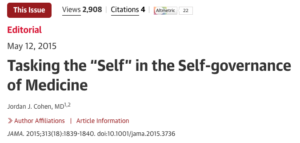
When we juxtapose Dr. Cohen’s words with those in a recent NEJM article evaluating the legislative record of Rep. Tom Price, we see stark contrasts. The NEJM piece, written by two HHS directors, says: “Price’s record demonstrates less concern for the sick, the poor, and the health of the public and much greater concern for the economic well-being of their physician caregivers.”
Jordan’s view: “Medicine’s social contract with society is the implicit, mutual understanding of the obligations physicians individually and collectively agree to on the one hand, and the privileges they are accorded by the public in return on the other hand. ‘Society grants physicians status, respect, autonomy in practice, the privilege of self-regulation, and financial rewards on the expectation that physicians would be competent, altruistic, moral, and would address the health care needs of individual patients and society’1… medicine in the United States enjoys an astonishing degree of autonomy. However, this skew also saddles medicine with an enormous degree of vulnerability for unwelcome constraints on that autonomy.”
He furthur cautions: “The hallmark of medical professionalism is a subordination of self-interest to the best interest of patients and the public.8 Maintaining that commitment to professionalism in the face of the many temptations afforded by today’s commercialized and overstressed health care system is, to be sure, no easy task. There are so many opportunities to give in to greed, to be arrogant, to abuse the power gradient inherent in the patient-physician relationship, to exploit conflicts of interest, to fail in the duty to be conscientiousness. But succumbing to temptations such as these, and abandoning the commitment to professionalism, is tantamount to physicians’ forfeiting the right to self-regulation.”
On “humanism”: “…humanism denotes an intrinsic set of deep-seated convictions about one’s obligations toward others.9 It is the passion that animates true professionalism. It is the passion that motivates many, if not most, young people when they choose a career in medicine. It is the passion that is all too often dampened by the rigors of medical education and by the hassles of medical practice. But it is the passion that must be nurtured, reinforced…”
And finally, on public trust: “No matter how effective professional organizations are in the pursuit of self-regulation, sustaining public trust in the profession is ultimately the responsibility of individual physicians being faithful to their obligation as professionals and being earnest in upholding the interest of their patients and the public…Trust in physicians is the foundation upon which the social contract with society rests. But trust in physicians is not a birthright. Trust is earned, not owed. The only way physicians can earn trust is by being trustworthy as true professionals.”
By endorsing Tom Price, the AAMC has granted him a “dehumanizing award”. The organization is much better than that.
Tags: #NotMyAMA > aamc > ama > HHS > Humanism in Medicine Award > JAMA > Jordan Cohen > NEJM > The AMA Does Not Speak For Us > Tom Price
Emory’s Center for Ethics, Tom Price, and AMA &AAMC 990’s: An Imagined Senior Seminar Class
Posted on | January 22, 2017 | Comments Off on Emory’s Center for Ethics, Tom Price, and AMA &AAMC 990’s: An Imagined Senior Seminar Class

Mike Magee
The recent endorsements by the AMA and AAMC of Tom Price to head HHS should provide a remarkable future senior seminar in situational ethics for Emory’s Center for Ethics and their much lauded “Health, Science & Ethics Pillar”. The case study’s syllabus will most likely include the recent AMA endorsement, the AAMC press release, and the congratulatory and laudatory pronouncements of the CEO of Emory Healthcare, Dr. Price’s original home base.
These will contrast with a range of other documents, including the recent critical NEJM article penned by two HHS directors which stated, “Price’s record demonstrates less concern for the sick, the poor, and the health of the public and much greater concern for the economic well-being of their physician caregivers.” Recommended readings will also include the 2014 990 IRS filings of the AMA and the AAMC, a collections of comments under #NotMyAMA, and an ever growing list of names on an online petition titled “The AMA Does Not Speak for Us”.
In Part I, question 1 of those 990’s, required of all non-profit organizations, students will find instructions stating “Briefly describe the organization’s mission or most significant activities. The AMA stated, “To further the interests of the medical profession by promoting the art and science of Medicine and the betterment of Public Health.” The AAMC wrote, “AAMC leads the Academic Medicine Community and strengthens the world’s most advanced medical care by supporting education, research, and patient care activities conducted by our member institutions.”
A careful reading will reveal that the two organizations combined assets exceeded $1.1 billion, and they employed just under 3000 individuals whose compensation exceeded $218 million that year. 546 of those employees received compensation of greater than $100,000. Combined, the programs and services offered that year generated $475 million in revenue. Almost half of the revenue generated by the AMA came from royalties and sales associated with their exclusive control of the nation’s CPT codes and the Physician Masterfile Database that fuels physician prescription profiling. Just under 2/3 of the AAMC revenue derived from three data driven and monopolistic product sales – ERAS (Electronic Residency Application Service – The Match: $69.2M), MCAT (Medical College Admission Test: $33.2M), and AMCAS (American Medical College Application Service: $30.4M).
Students will surmise from these two organization’s strong and immediate public support for HHS candidate Tom Price that both organizations also support political action, but in two different forms. They will find that the AAMC is a non-profit 501(c)3. These organizations are “absolutely prohibited from engaging in political campaign activities…ie. election or defeat of a candidate.” “Insubstantial lobbying” however is allowed. The IRS doesn’t use the word “lobby” but rather the phrases “carrying out of propaganda” and “attempting to influence legislation”.
The AMA, in contrast is a 501(c)6, as are the National Football League, the American Bar Association, and the Independent Insurance Agents of America. Student research will reveal that these non-profits are permitted to engage in unlimited lobbying, and may engage in political activity, but are required to pay a 35% excise tax on their total political expenses. However, these activities may not be “the organization’s primary activity”.
The AAMC 990 will reveal 2014 listed expenditures of $3.9 million under the title “Influencing public opinion or legislation”. The report will further explain that “The other activities include meeting with or calling government officials or legislators, placing advertisements and issuing press releases to direct the organizations efforts to influence public opinion on legislative matters”.
Students querying Maplight and Open Secrets will report to the class that AMA lobbying expenditures for 2014 were in the area of $20 million. That funded close to 50 lobbyists (including 24 registered AMA employees) generating over 100 reports, many to effect the outcome of 81 different pieces of legislation. Those lobbyists made 43 visits to the House, 42 to the Senate, 17 to HHS, 15 to CMS, 11 to the White House plus 5 to the Executive Office Building, and 8 to the FDA.
In an interview with one of those future students who will reach out to me for comment, I will report that, “In a conversation with the then CEO of the AMA some years back, he expressed his desire to move the AMA headquarters to Washington since this was the organization’s primary focus. He was just being honest.” The student however will not be able to validate this in the public record. However, she will surmise that these inconsistencies may, in part, explain why only 17% of the nation’s doctors are AMA members. But she will also wonder out loud whether that matters with the AMA Federation of state and specialties in its hip pocket, and non-member revenues from CPT and Physician Masterfiles a monopolistic lock.
The students in general will not express surprise at the AMA’s full-throated endorsement of Tom Price. Their spread sheets will reveal that some Federation members went along (ACS, AAFP, a spattering of medical and surgical sub-specialties), and others went mute (AAP, ACOG, ACP-ASIM). One student, in open class discussion, will wryly remark that ”Apparently, for these organization members, you are part of the Federation, except when you’re not. What’s not to like?” Others with public health aspirations and “generalism” in their bones will wonder aloud why Family Medicine doctors at the time tolerated an endorsement of such a socially compromised legislator as Tom Price without a huge human outcry from AAFP members.
One student, an aspiring physician scientist, will sternly proclaim that “the halo around the head of the AAMC is undeserved.” He will explain to the others that the organization is governed by giant academic hospital enterprises, detached entrepreneurial medical school deans, and the vaulted “thought leaders” of medical research in America, now nearly indistinguishable from their industry counterparts. He will explain that he is deeply conflicted since support of the organization and its entities is all but essential to his own career advancement including access to NIH grants, publications, and placement on government and industry advisory committees in the future.
He’ll say he feels “ethically trapped”, supporting as he does the AAMCs highly publicized focus on new medical school curriculum, advances in physician empathy, and concerns for hospital safety and the rights of human research subjects, but dismayed by his own course work which reveals “conflict of interest in publications, patient advocacy organizations and in Twitter postings for God’s sake”. He’s especially dismayed that his own school’s top health care officer openly and enthusiastically supported the successful nomination of Emory’s former orthopedist Tom Price, who went on (after his confirmation) “to lead the nation’s survival curve, not just for the vulnerable but for everyone, due south.”
In the final week of this high level seminar class, the professor will assign her 12 students to provide four concrete recommendations that might address their concerns and begin to re-establish appropriate checks and balances. The following week, they will return with these recommendations, provided in writing on a piece of Emory stationary. It will read:
1. In this trumpian era, every single doctor in America needs to make a list of all the organizations of which each is a member or a provider, including medical associations, hospitals and health systems.
2. Each must then ask, “Are any of these associated with, represented by, or a collaborator with the AMA or AAMC?”
3. If the answer is yes, you must consider yourself a member as well, because you are!
4. Now you must determine what you are going to do about it.
More next week.
Tags: #NotMyAMA > 501c3 > 501c6 > aamc > affordable care act > ama > Donald Trump > Emory Center for Ethics > Emory Health Science & Ethics Pillar > HHS > Jonathan Lewin > medical ethics > non-profit law > Obamacare > President Trump cabinet nominations > The AMA Does Not Speak For Us > Tom Price

"Code Blue INDEX online"


Prospective Health Blog
BIOGRAPHY

NIH Precision Medicine
BIOGRAPHY

Health in 30
BIOGRAPHY

Larry's Letters
BIOGRAPHY

Precision Medicine, Euthanasia, Abortion, Communism, Trillions of Dollars, Losing Freedom, and Town Hall Mobs BIOGRAPHY

Yearning for Universal Coverage Is Not Universal
BIOGRAPHY

